Sustainable Fuels
Decarbonization of aviation, international shipping, and long-haul trucking is necessary to reduce the carbon dioxide emissions produced by the transportation sector. Sustainable fuels, including biofuels and electrofuels (e-fuels), could offer a promising solution for deep decarbonization of these hard-to-abate sectors if technical and economic barriers can be overcome.
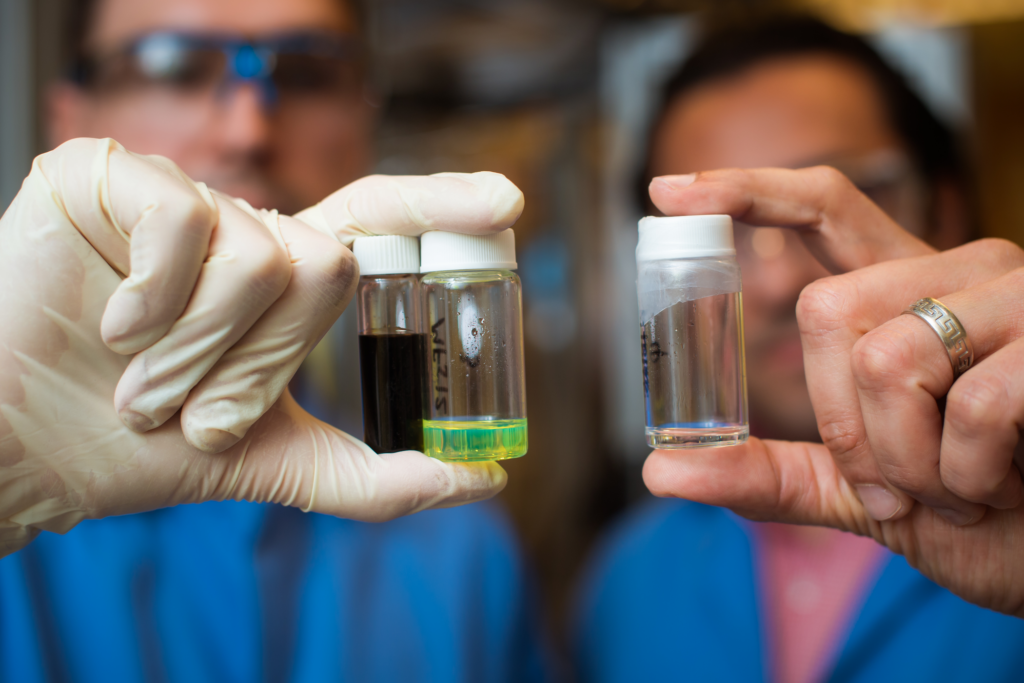
The aviation, international shipping, and long-haul trucking sectors will be challenging to decarbonize due to their reliance on energy-dense liquid fuels that are usually petroleum-based. Sustainable fuel alternatives could achieve lower net greenhouse gas emissions depending on their feedstocks and production pathways. However, they cannot currently be produced as inexpensively as petroleum-based fuels.
Sustainable fuels include biofuels derived from crops, agricultural or forest residues, or waste oils, and electrofuels (e-fuels) formulated by combining hydrogen with captured CO2 to produce synthetic versions of today’s liquid fuels. Each of the many potential feedstocks and pathways for producing sustainable fuels has different carbon intensity, cost, supply chain, and scalability. The lifecycle emissions of each sustainable fuel depend heavily on the feedstock and the energy source used in fuel production, especially for e-fuels. Making sustainable fuels a widely-adopted alternative to petroleum-based fuels will require addressing technical, scalability, and economic barriers through both innovation and supportive policies.
“Today the cost of producing sustainable fuels is high and they cannot be supplied at scale. That raises some questions. The time is right for us to work together to assess the status, the potential, and the next steps needed for sustainable fuels.”
Randall Field
Executive Director, MITEI Future of Fuels: Pathways to Sustainable Transportation study, MITEI director of research
Videos
Research
-
August 2025
MITEI Geologic Hydrogen Consortium
-
August 2025
Low-carbon fuels for light-duty vehicles
-
December 2024
Opportunities for class-leading hydrogen sensors
-
September 2024
Analysis of national hydrogen supply chain scenarios
-
September 2024
Pathways towards gigaton scale low-carbon H2 production
Publications
-
September 2021
Bulk permeability characteristics in a biomass moving bed and their effects on reactor design and scaling
Moving or fixed bed reactors are commonly used for continuous processing of biomass in a wide range of applications, such as torrefaction, slow pyrolysis, gasification, and incineration. Many of these… Read more
-
June 2019
A decentralized biomass torrefaction reactor concept. Part II: Mathematical model and scaling law
In Part I of the study, we proposed a simplified biomass torrefaction moving bed reactor design capable of decentralized, small-scale, and mobile deployment operated under an oxygen-lean condition. We built… Read more
-
June 2019
A decentralized biomass torrefaction reactor concept. Part I: Multi-scale analysis and initial experimental validation
A new, simplified biomass torrefaction reactor concept that operates under oxygen-lean conditions is proposed as a potential way to downscale torrefaction reactors for small- and medium-scale applications. To verify the… Read more
-
February 2022
Electrochemical Activation of C−C Bonds through Mediated Hydrogen Atom Transfer Reactions
Activating inert sp3 -sp3 carbon-carbon (C-C) bonds remains a major bottleneck in the chemical upcycling of recalcitrant polyolefin waste. In this study, redox mediators are used to activate the inert… Read more
-
April 2019
Cooperative Co0/CoII Sites Stabilized by a Perovskite Matrix Enable Selective C−O and C−C bond Hydrogenolysis of Oxygenated Arenes
Strontium-substituted lanthanum cobaltite (La0.8 Sr0.2 CoO3 ) matrix-stabilized Co0 /CoII catalytic sites were prepared, which present tunable C-O and C-C hydrogenolysis activity for the vapor-phase upgrading of oxygenated arenes. CoII… Read more
-
September 2020
Conversion of Methane into Liquid Fuels—Bridging Thermal Catalysis with Electrocatalysis
The direct partial oxidation of methane to methanol promises an energy‐efficient and environmental‐friendly utilization of natural gas. Unfortunately, current technologies confront a grand challenge in catalysis, particularly in the context… Read more
-
April 2023
Externally Tunable, Low Power Electrostatic Control of Cell Adhesion with Nanometric High‐k Dielectric Films
Controlling cell adhesion to surfaces is an important, but difficult, problem. Current methods to control adhesion rely on surface functionalization, which have limited material choice to avoid cell toxicity and… Read more
-
February 2015
A Path Forward for Low Carbon Power from Biomass
The two major pathways for energy utilization from biomass are conversion to a liquid fuel (i.e., biofuels) or conversion to electricity (i.e., biopower). In the United States (US), biomass policy… Read more
-
February 2008
Biomass to Ethanol: Potential Production and Environmental Impacts
This study models and assesses the current and future fossil fuel consumption and greenhouse gas impacts of ethanol produced from three feedstocks; corn grain, corn stover, and switchgrass. A life-cycle… Read more
-
June 2007
Ethanol: A Look Ahead
Current and future environmental impacts of potential bioethanol production pathways are examined by incorporating a Monte Carlo uncertainty analysis within a life cycle model to account for system variability. Compared… Read more
News













People
MIT faculty and researchers who are working on the challenges of sustainable fuels.












































future of fuels study
A MITEI-led study on sustainable fuels was launched in winter 2026 and is analyzing and assessing promising feedstocks and pathways for production of sustainable fuels, including biofuels derived from biomass and e-fuels derived from hydrogen and carbon dioxide. The two-year study will include a comparison between sustainable drop-in fuels and the major non-drop-in fuels, such as renewable methanol, ethanol, ammonia, and natural gas . A key aspect of the study will be analysis of the current domestic and international policies that shape the decarbonization of long-distance transportation, as well as policies that could enable a more efficient trajectory for this energy transition.
Bill Green, MITEI director and Hoyt C. Hottel Professor of Chemical Engineering, is leading the study, and Randall Field, MITEI’s director of research, serves as executive director. MIT faculty research staff, and postdoctoral researchers round out the study’s team of engineers, scientists, and policy experts. An advisory board, consisting of one individual from each funding organization, as well as invited experts from academia, nongovernmental organizations, and government labs, provides the study team with feedback and guidance regarding the study’s mission.
At the end of the study, the team will release a public report on results, findings, and recommendations, as well as present the major findings and recommendations from the study via a webcast.
Questions about the scope, technical approach, and study logistics may be addressed to Randall Field at rpfield@mit.edu. Questions about joining the study and the advisory board may be addressed to J.J. Laukaitis, MITEI director of member relations, at jjlaukai@mit.edu.