The Hydrogen Carrier Analysis Tool (HyCAT), developed by a MITEI-led team, helps users determine the costs and carbon emissions incurred when transporting and delivering hydrogen fuel.
Hydrogen: The clean-burning fuel of the future—if we can find a cheap and clean way to ship it
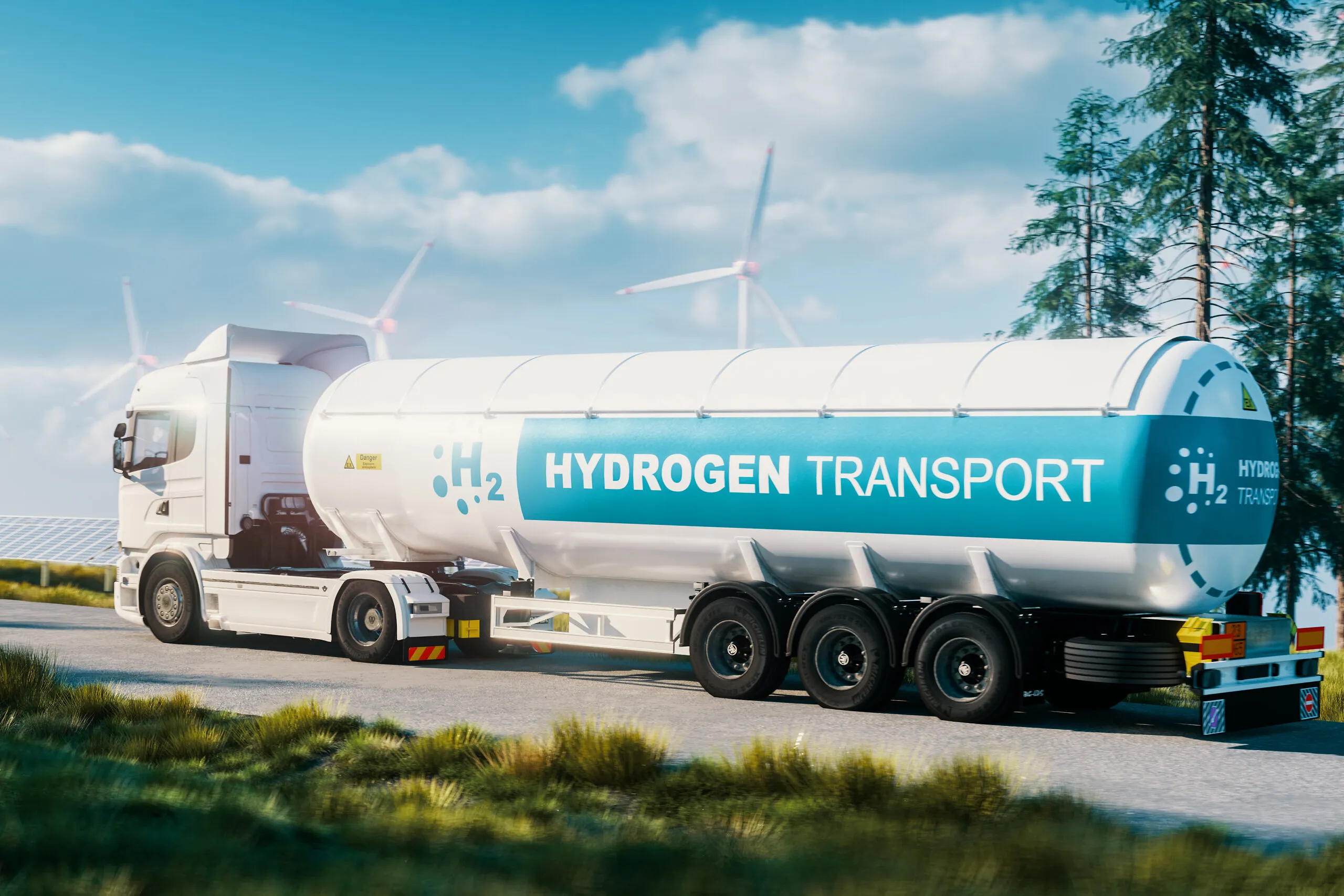
Shutterstock
A team led by MIT Energy Initiative researchers has developed a tool that enables decision makers to explore the cost and carbon emissions of their options for shipping hydrogen fuel to their site.
Research areas
Many experts refer to hydrogen as “the fuel of the future.” It is expected to help decarbonize the global economy in two main ways: Burning it or feeding it into a fuel cell produces storable energy with no carbon emissions, just water. And it can be used in place of fossil fuels or as a chemical feedstock in hard-to-decarbonize industrial processes such as steel and cement production.
But for hydrogen to realize its potential two challenges must be overcome. Researchers worldwide are now working to address the first: finding a method of producing pure hydrogen that’s both cheap and low in carbon emissions.
Just as critical is finding a good means of transporting and storing hydrogen. A team led by researchers at the MIT Energy Initiative (MITEI) has been tackling that less-discussed but important challenge. The location where the pure hydrogen is produced is likely to be far away from where it will be used, so moving it will be critical—and difficult.
The problem stems from two characteristics of hydrogen: It’s the lightest gas there is, and it has low energy density per volume. Therefore, delivering a given amount of energy requires a large volume of hydrogen and a container that’s sealed so tightly that the hydrogen molecules can’t escape. Suffice it to say, moving a liquid fuel such as gasoline is easier. And without a good means of storing and transporting hydrogen, it can’t fulfill its promise as the world’s clean fuel of the future.
In 2024, with funding provided by ExxonMobil Technology and Engineering Company through MITEI, a team of MITEI researchers and their ExxonMobil colleagues began examining various approaches to transporting hydrogen. The study was led by former MITEI postdocs Gasim Ibrahim, now an R&D engineer/scientist at Honeywell, and Guiyan Zang, former MITEI group lead and now an associate professor at Washington State University. The researchers concluded that there’s no single answer: The cost and carbon emissions from a given transportation method will vary from one location to another. Therefore, instead of presenting a table showing the “best” outcome, the team created a tool that enables users to understand the various options and choose the best option for their particular use case.
The hydrogen challenge and hydrogen “carriers” that can help
The team’s starting assumption was that for hydrogen to become a viable fuel for the world, it would need to be transported over long distances, specifically, overseas, across continents, or across large water bodies. Given the properties of hydrogen gas, it would be best to convert it to some liquid form before shipping.
There are known ways to do that, but what would be best for shipping? How much would various methods cost, and how much would they add to the carbon intensity of the delivered hydrogen? “There hasn’t been a lot of attention paid to addressing those questions,” Ibrahim says. While some studies have been done, their conclusions are inconsistent and many uncertainties remain, both because the cost and carbon emissions will differ from place to place and because there’s not a lot of data to inform how the large-scale transportation of hydrogen will work.
“So we decided the best thing to do was to develop an adaptive tool that would enable users to perform their own assessments—a tool that could be updated very easily,” he says. “And we would make it open source, so anyone can see and update the numbers that we used in formulating and testing it. As the industry develops, and as scale becomes more a factor, the assumptions made in [our initial] assessments of the economics and the carbon intensity [of different shipping methods] will need to be updated.”
To focus on the transportation and storage issues, their model—called the Hydrogen Carrier Analysis Tool, or HyCAT—doesn’t consider how the starting hydrogen is produced or how the hydrogen is used after it’s delivered. HyCAT focuses on determining the costs and carbon emissions incurred as the hydrogen is transported and delivered. In addition, while a full lifecycle assessment would include all environmental impacts, HyCAT focuses on emissions of greenhouse gases (GHGs).
The tool is easy to use, says Ibrahim. Built into it is a user interface with drop-down menus for inputting assumptions, and results from an analysis are presented in simple bar charts that include links to tables presenting the details.
Ibrahim clarifies that, while HyCAT has a well-defined boundary—“incoming hydrogen to outgoing hydrogen”—in an analysis of a specific situation, the user will input various factors about the local situation, including the carbon intensity and cost associated with production of the incoming hydrogen. “So that will inform the final values that come out of a HyCAT analysis,” says Ibrahim, and in part explains why the results vary from place to place.
Based on the user’s assumptions, HyCAT calculates the cost and GHG emissions at five steps in the “supply chain”:
- converting the hydrogen into liquid form at the “export” terminal;
- storing the hydrogen-rich liquid;
- shipping it when an empty tanker becomes available;
- storing it at the “import” terminal;
- releasing the hydrogen as a gas suitable for burning or being fed into a pipeline for distribution.
Options for liquifying hydrogen gas
The main decision in analyzing the cost and emissions of a proposed hydrogen transport plan is how to convert the gaseous hydrogen to a liquid and then how to recover the hydrogen gas at the end.
One approach is to simply change the gaseous hydrogen into an easily transportable liquid. But turning hydrogen gas into a liquid requires making it very, very cold. Indeed, notes Ibrahim, “You would need to consume about a third of the energy content of the hydrogen to make the gaseous hydrogen cold enough to liquify.” A further problem arises as the liquified hydrogen is being stored and moved. Unless the vessel containing the liquid hydrogen is properly insulated, the liquid hydrogen can re-gasify and escape. The upside of hydrogen liquefaction is that no chemical reactions are required.
Other options involve using a hydrogen “carrier.” Some liquid chemical compounds will absorb hydrogen atoms under certain conditions and under other conditions will release them. Therefore, one approach to solving the hydrogen transportation problem is to make a carrier compound absorb the hydrogen where it’s made and then release it when it reaches its destination. This approach therefore involves two chemical reactions—one to bind the hydrogen to the carrier and the other to release it.
In their demonstration runs, the researchers looked at the hydrogen carriers involving three potential compounds, each of which has known advantages and disadvantages.
One of those carriers is produced by adding hydrogen to toluene. That chemical reaction hasn’t been studied a lot, but there’s one known drawback: The source of toluene is typically the oil and gas industry, so the toluene itself has a relatively high carbon intensity when it picks up the hydrogen. Moreover, over time some of the toluene is lost, so more toluene must be added.
The researchers also looked at “synthetic methane,” which is made by reacting hydrogen with carbon dioxide. That reaction has been known for some time. Ibrahim notes that making synthetic methane actually consumes carbon dioxide, often captured from the atmosphere. On the negative side, however, one of the products of the reaction is water, so some of the hydrogen is lost each time the reaction occurs.
The final option they analyzed is ammonia, which forms when hydrogen reacts with nitrogen from the air. That reaction is very well-studied and is used commercially. “We’ve been producing ammonia for a long time,” says Ibrahim. And the infrastructure for transporting and storing it is well established. While Ibrahim refers to ammonia as the “most promising option,” the reaction needed to release the hydrogen has not received much attention.
Varying conclusions and future plans
Based on their sample runs, the researchers observed that the best path to follow will vary from place to place and from situation to situation. “As we developed the tool, we saw that the ‘best’ carrier was very specific to the supply chain at hand,” says Ibrahim. “It’s a function of how far you’re trying to ship your hydrogen, energy and shipping costs at your exporting and importing countries, the capital cost of building the needed facilities at both ends, and more.”
Ibrahim and his team are now planning a follow-up study in which they use HyCAT to analyze specific supply chains under certain conditions. They’ll then select assumptions that are highly uncertain and look at the range of possible values for those assumptions. “Then we’ll be able to say, ‘Under these conditions, this carrier is better than that one,’ or ‘This carrier is better at cost but worse at carbon intensity,’” says Ibrahim.
For now, the main conclusion of the study, says Ibrahim, is that “there’s no conclusion.” He warns decision makers not to assume that anything they see in the literature can easily be generalized or extrapolated to their specific conditions. Instead, decision makers should use HyCAT to explore the options available to them. Guided by their results and the objectives and values of their company, they will be able to optimize their supply chains and make clean-burning hydrogen a reality.

