MITEI Director William H. Green, the Hoyt C. Hottel Professor of Chemical Engineering at MIT, gave the Hottel Lecture during the opening ceremony of the Combustion Institute’s biennial symposium in Kyoto, Japan.
MIT Energy Initiative Director awarded Jürgen Warnatz Gold Medal for contributions in combustion science
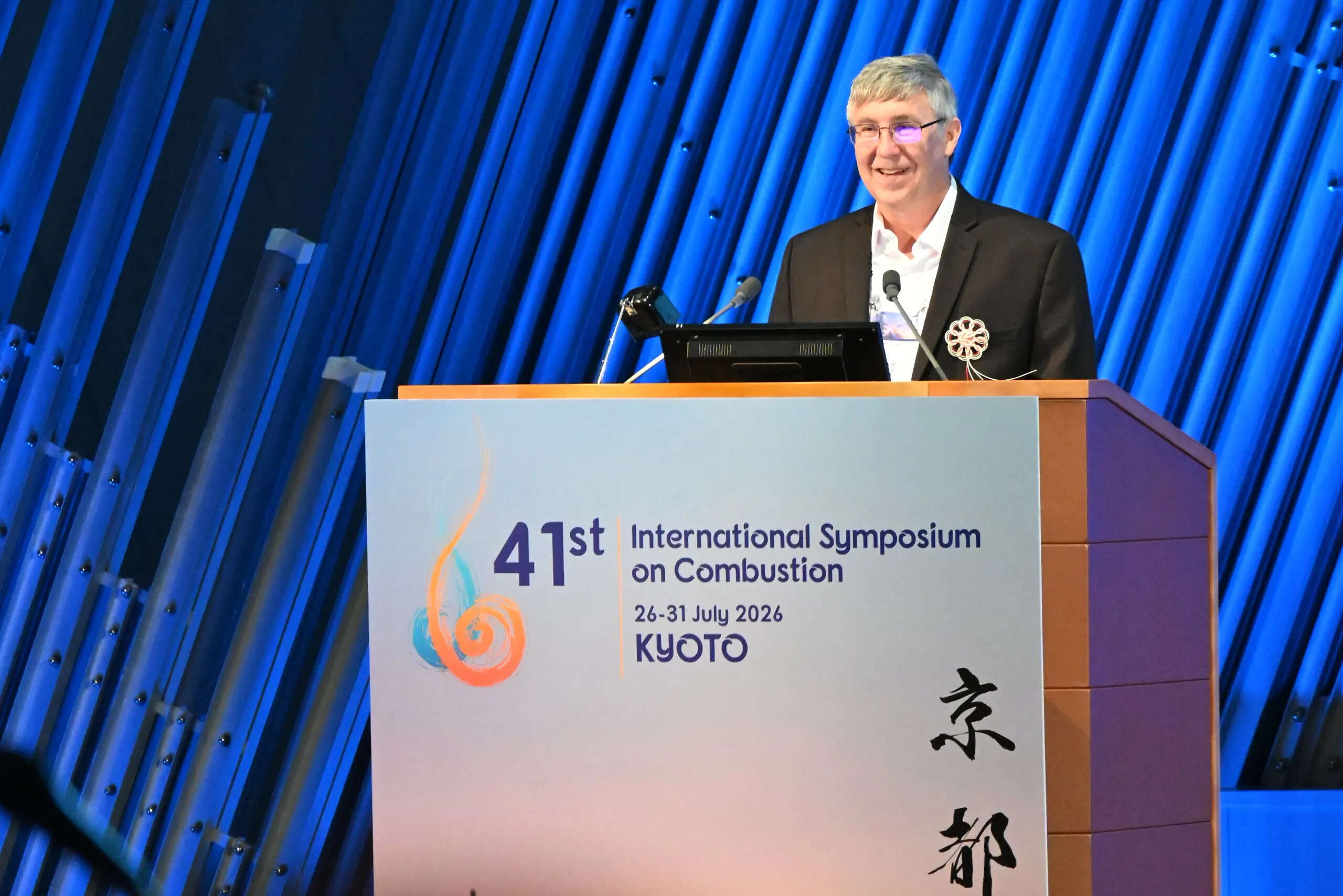
MIT Energy Initiative Director William H. Green received the Jürgen Warnatz Gold Medal from the Combustion Institute at its biennial symposium in Kyoto, Japan.
Research areas
MIT Energy Initiative Director William H. Green was awarded the prestigious Jürgen Warnatz Gold Medal at the 41st International Symposium on Combustion in Kyoto, Japan, on July 30.
The Warnatz Medal is one of the highest awards of the Combustion Institute and is presented biennially to one scientist in recognition of exceptional scientific contributions having a major impact on combustion applications or research. The award citation recognized Green “for visionary leadership in developing cutting-edge computational tools that have reshaped the prediction of combustion chemistry and the handling of large kinetic mechanisms.”
“I am deeply honored to be chosen for this award,” said Green. “This honor also recognizes the hundreds of wonderful collaborators, postdocs, and students I have worked with over the past three decades. Our fruitful work together has made it possible to quickly design alternative fuels and new combustion systems on the computer.”
Over the past 30 years, Green's research group has pioneered computational tools for predicting combustion chemistry from first principles. The group has built and maintains the Reaction Mechanism Generator (RMG), an open-source software platform that automates the construction of detailed chemical kinetic models. This approach has facilitated the design of lower-emission combustion systems and alternative fuels compatible with proposed high-efficiency engines and has also led to the discovery of new high-temperature chemical processes.
In recent years, Green's group has extended methods originally developed for combustion and pyrolysis to predict the behavior of a broad range of lower-temperature reactive systems. These include applications in atmospheric chemistry, geochemistry, pharmaceutical development, catalysis, and lithium-ion battery degradation. All of these predictions rely on estimates of molecular and reaction properties. Most recently, Green and his collaborators have developed open-source machine-learning tools such as the widely adopted Chemprop and CheMeleon software packages, which greatly improve the accuracy of the estimates.
Green, the Hoyt C. Hottel Professor of Chemical Engineering at MIT, also gave the invited Hottel Lecture during the symposium’s opening ceremony. This marked the first time that a researcher holding a university chair named for Hottel, an icon of 20th century research on fuels, combustion, and solar energy and long-time MIT professor, was chosen to deliver the Combustion Institute’s prestigious Hottel Lecture. The keynote address was delivered in the same historic hall where the 1997 Kyoto Protocol was adopted at the third United Nations Climate Change Conference.
In the Hottel Lecture, Green acknowledged that combustion science is facing challenging times, with some arguing that the field is in danger of becoming irrelevant. Green refuted this perspective, noting that all decarbonization pathways required to reach climate goals rely on combustion research to develop new solutions. Green also noted that combustion science is rapidly incorporating AI, adding that his group’s RMG software has shown how computational tools can replace costly experiments and accelerate innovation.
Green closed the Hottel Lecture with four calls to action: He encouraged researchers to engage rigorously with techno-economic and life-cycle assessments to ensure combustion innovations will meet societal needs and are fairly evaluated alongside alternatives; to communicate the field's value to audiences beyond the combustion community; to pursue multidisciplinary collaboration on energy solutions; and to adopt open sharing of data, models, and software to accelerate research progress.
The International Symposium on Combustion is hosted by the Combustion Institute and is considered the premier meeting of combustion researchers. It brings together about 2,000 attendees, features about 1,600 presentations, and introduces innovative research in combustion science. The Combustion Institute, founded in 1954, is based in Pittsburgh and promotes and disseminates research in all areas of combustion science and technology.

