Iron & Steel Decarbonization Technologies
The iron and steel industry underpins much of the global economy, from basic infrastructure to buildings to equipment. Production processes are energy-intensive and difficult to decarbonize.
Global iron and steel production
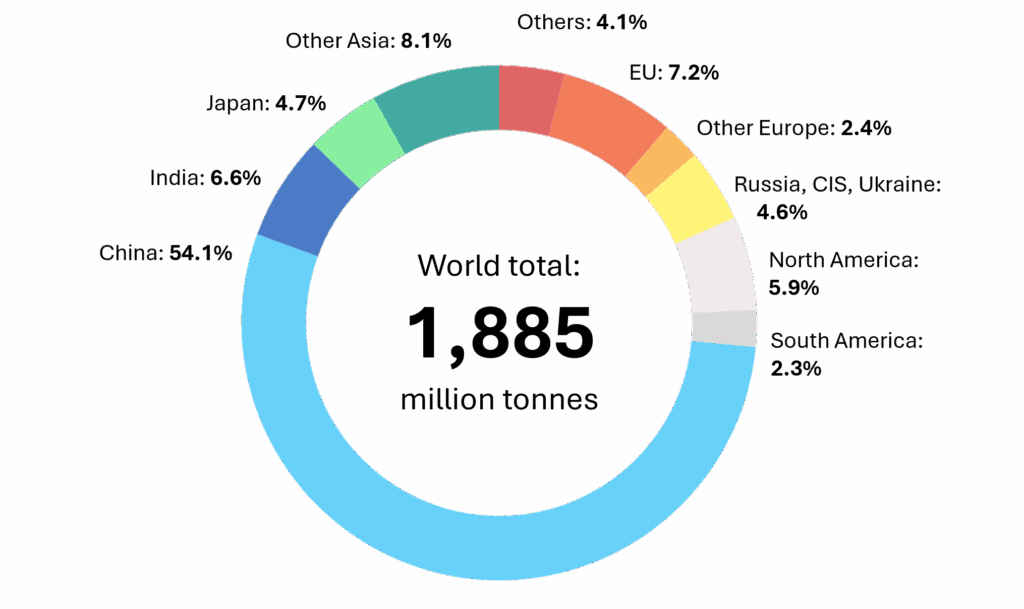
7%
of annual global energy is used in iron & steel production
8%
of global GHG emissions come from iron & steel production
Iron and steel manufacturing is one of the largest consumers of global energy and one of the largest contributors to carbon dioxide (CO₂) emissions. To enable deep decarbonization, there is an urgent need to identify practical, scalable solutions. Research worldwide is exploring the impacts of technology shifts, fuel switching, and carbon capture and storage (CCS) on energy use, cost, and emissions in crude steel production. This technology dashboard tracks key current and emerging steelmaking technologies and highlights key decarbonization signposts for real impact.
Iron & steel production technologies
- BF-BOF (Blast Furnace – Basic Oxygen Furnace)
- SR (Smelting Reduction)
- DRI-EAF (Direct Reduced Iron with Electric Arc Furnace)
- MOE (Molten Oxide Electrolysis)
Quick Facts
Steel demand is distributed as follows:
52% buildings and infrastructure
16% mechanical equipment
12% automotive
10% metal products
5% other transport
3% electrical equipment
2% domestic appliances
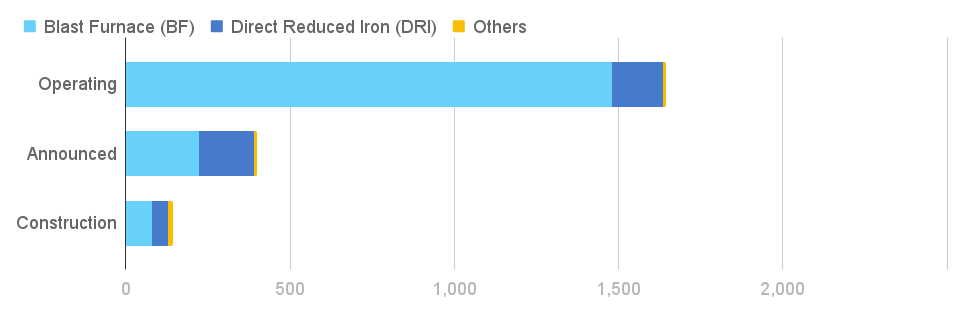
Ironmaking capacity by status and technology type
Global steel use averages more than
220 kg
per person
The average CO2 intensity of production
BF-BOF
DRI-EAF
Scrap EAF
2.32 kg/tonne
1.43 kg/tonne
0.70 kg/tonne
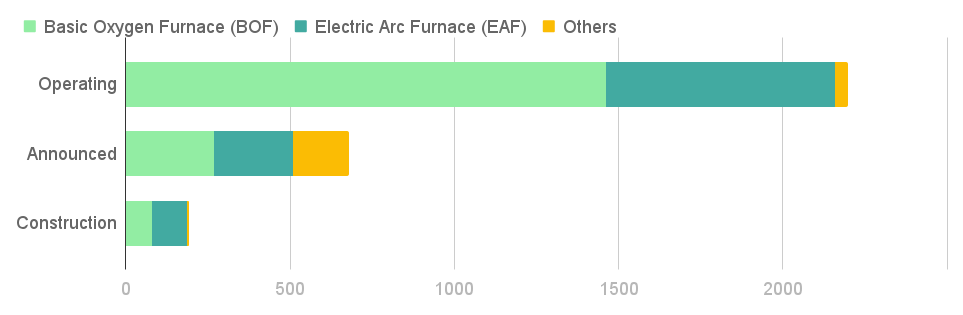
Steelmaking capacity by status and technology type
Comparisons of technologies
Techno-economic analysis (TEA) and lifecycle analysis (LCA) are used to evaluate how technology shifts, fuel switching, and CCS affect energy demand, cost, and emissions across different crude steel production pathways.
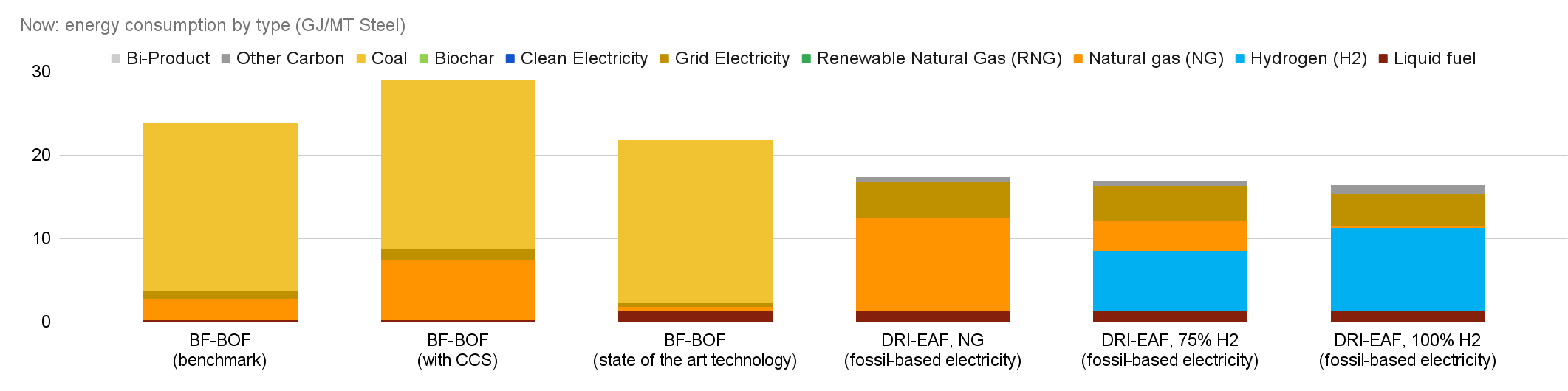
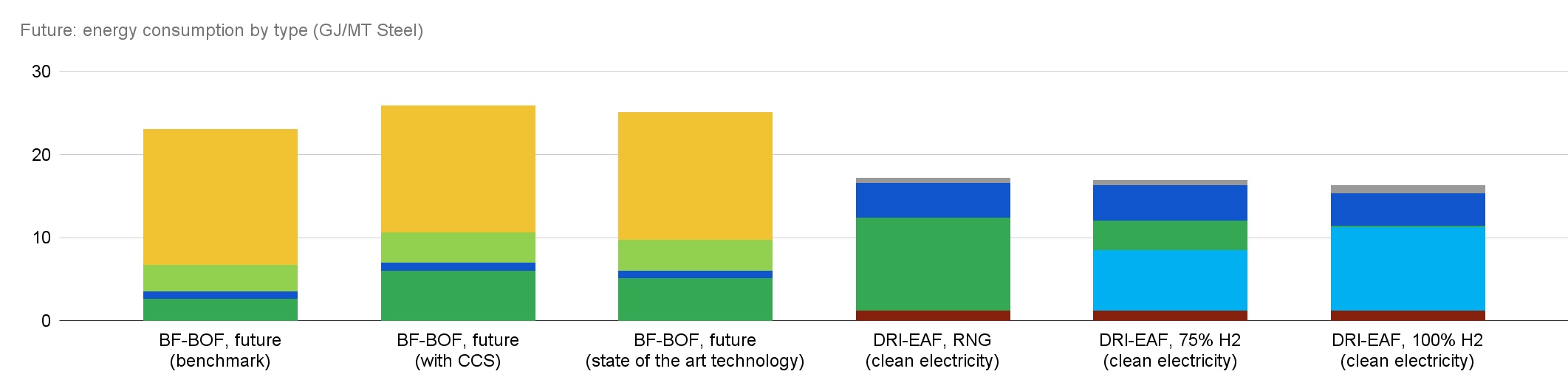
Energy consumption and resource utilization: Now and future
Shifting energy resources from coal, liquid fuels, natural gas and carbon intensive electricity to biochar, renewable natural gas, and clean electricity will be critical to improving sustainability.
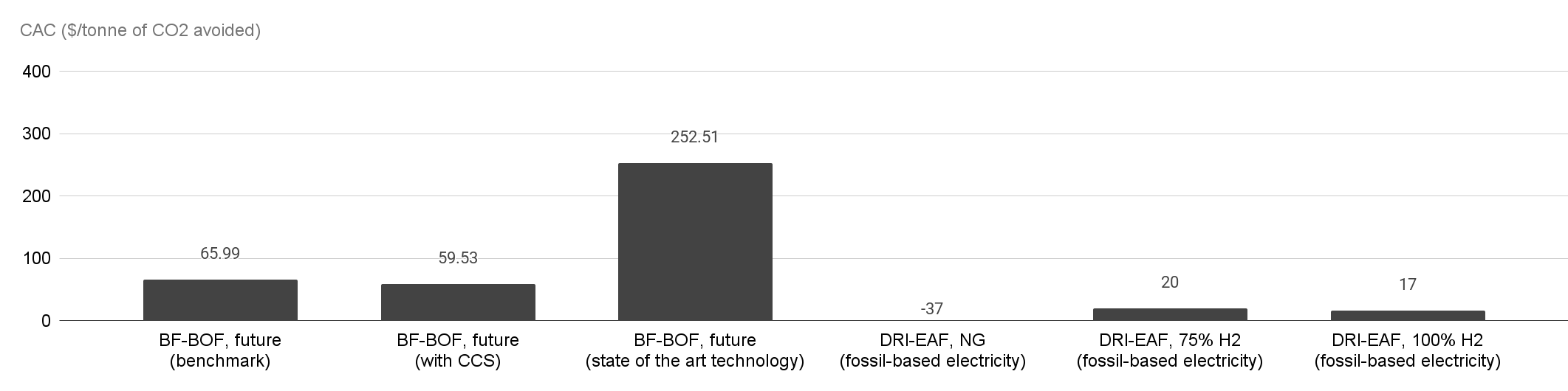
Carbon avoid cost (CAC)
In most regions, fuel switching and CCS would provide the most cost effective decarbonization pathway for existing mainstream BF-BOF; the cost of carbon avoidance (CAC) would be prohibitively high building new state-of-the-art facilities. Hydrogen-based DRI technologies, even with traditional fossil-based electricity, can be competitive for replacing BF-BOF if low-cost hydrogen is available.
Signposts
Signposts track critical parameters to identify changes that indicate conditions for market adoption are shifting, and further assessment is warranted. Signposts include cost, technology performance, policy, and market signals.
Technology


Emerging-solutions continue to evolve – some offer low emissions with mature TRLs but remain costly, while others have met cost targets but are not yet technologically ready.
Policy signposts
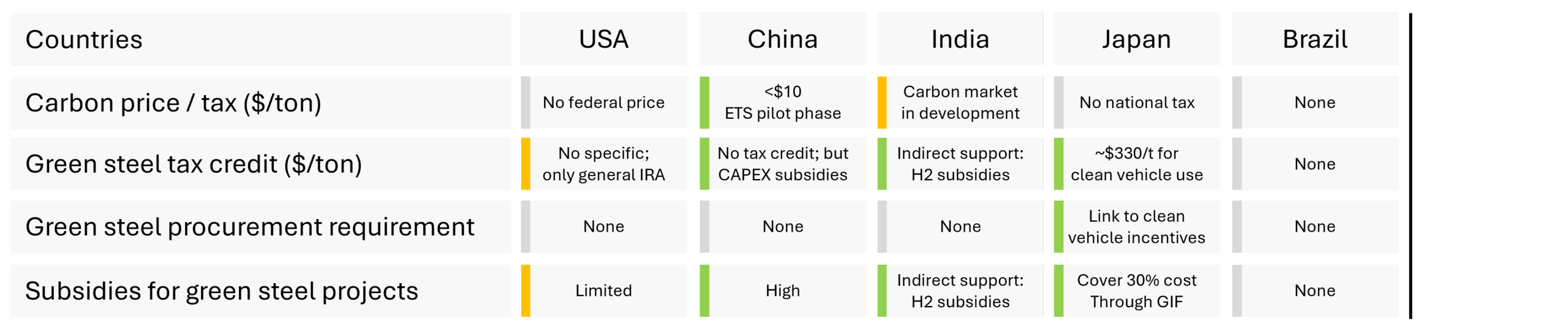
Policy support for green steel varies widely across regions. The USA offers general clean tech support under the Inflation Reduction Act but lacks steel-specific incentives or mandates. China has a low-carbon price but provides significant state subsidies. Japan offers targeted incentives through clean vehicle programs and R&D funding. India is in the early stages, focusing on hydrogen support and pilot initiatives. Brazil shows limited policy activity to date.
Market signposts

The green steel market is still in the early stage. The USA is making early investments in green steel leveraging federal funding, but market demand and adoption remain limited. China is ramping up with large-scale investment plans and growing industrial demand, including early export activity. Japan is expanding Electric Arc Furnace (EAF) capacity with significant funding, though offtake agreements are still emerging. India and Brazil are in the early stages, with limited reported investment and minimal low-carbon steel market presence.
Trajectory
Potential decarbonization trajectory
The decarbonization trajectory describes options for a potential pathway to reduce the emissions impact of iron & steel production. The elements of the pathway are arranged by approximate degree of cost, effort, and complexity from easier (short-term) to more challenging (long-term).
Short-term:
Performance boost
-7%
CO2e Reduction
- Increase efficiency: waste heat and gas reuse/reduction
- Introducing renewables: on-site solar
Mid-long term:
Process change
-25%
CO2e Reduction
- Feedstock switching: DRI (HBI)
- BF H2-injection
- Small-scale CCUS
- Co-site CH4 production using CO2
Long-term:
Radical change
-75%
CO2e Reduction
- Clean electricity/fuel
- CCS
- New production method DRI, FIT-H2
Relevant Projects
References
IEA, “Iron and steel technology roadmap,” International Energy Agency (IEA), Paris, 2020.
https://www.iea.org/reports/iron-and-steel-technology-roadmap
E. Basson, “2023 world steel in figures,” Worldsteel Association, Brussels, Belgium, 2023.
https://worldsteel.org/wp-content/uploads/World-Steel-in-Figures-2023-4.pdf
“Global Iron and Steel Tracker”, Global Energy Monitor, 2024.
https://globalenergymonitor.org/projects/global-iron-and-steel-tracker/
H. Ritchie, “Sector by sector: Where do global greenhouse gas emissions come from?” Our World in Data, 2020.
https://ourworldindata.org/ghg-emissions-by-sector
IEA, “Net zero by 2050,” International Energy Agency (IEA), Paris, 2021.
https://www.iea.org/reports/net-zero-by-2050
J. Cresko, “Industrial decarbonization: Opportunity, challenges and R&D needs,” U.S. Department of Energy (DOE), 2021.
https://www.cibomembers.org/wp-content/uploads/2021/06/EE_JUN21_Cresko-Industrial-Decarbonization-J.pdf
G. Zang, et. al., “Cost and life cycle analysis for deep CO2 emissions reduction of steelmaking: Direct reduced iron technologies,” Steel Research Int., vol. 94, no. 6, p. 2 200 297, Jan. 2023.
https://onlinelibrary.wiley.com/doi/10.1002/srin.202200297
G. Zang, et. al., “Cost and life cycle analysis for deep CO2 emissions reduction of steelmaking: Blast furnace-basic oxygen furnace and electric arc furnace technologies,” International Journal of Greenhouse Gas Control, vol. 128, p. 103 958, Sep. 2023. https://doi.org/10.1016/j.ijggc.2023.103958
S. Johnson, “Analysis of steel decarbonization strategies and supply chain integration,” Ph.D. dissertation, Massachusetts Institute of Technology, Cambridge, MA, 2023.
https://dspace.mit.edu/handle/1721.1/159954
C.-L. Mai, “Identification of The Steel Decarbonization Options for Different Regions” Master thesis, Massachusetts Institute of Technology, Cambridge, MA, 2024.
https://dspace.mit.edu/handle/1721.1/155996