clear
The Consistent Lifecycle and Economic Assessment Recommendations (CLEAR) initiative: Standardized techno-economic analysis (TEA) and lifecycle assessment (LCA) frameworks will allow investors and policymakers to reliably compare the costs and emissions impact of emerging energy and climate technologies.
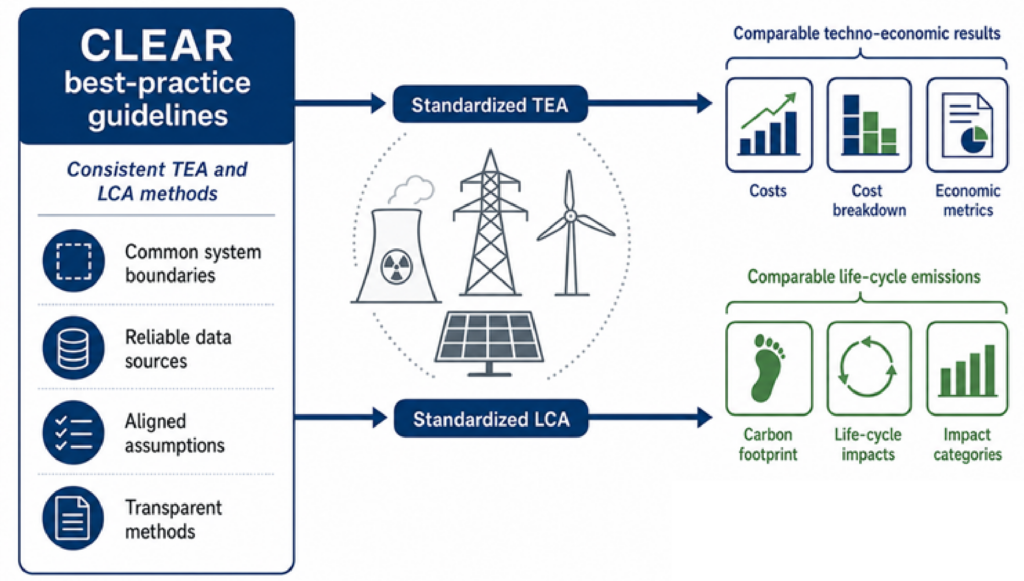
The viability of emerging energy and climate technologies is frequently obscured by inconsistent approaches or assumptions within techno-economic analyses (TEA) and lifecycle assessments (LCA). Research groups, companies, and software packages often adopt different approaches to cost estimates and greenhouse gas (GHG) emission assessments, producing divergent results. This lack of agreement erodes confidence in technology assessments and can delay adoption of innovative decarbonization solutions.
A standardized framework for TEA and LCA would enable investors, policy makers, and the public to compare emerging energy and climate technologies on a level playing field. Adopting such a framework could also facilitate policy and market decisions needed for more rapid decarbonization of key sectors.
“With CLEAR, MIT is collaborating with experts in academia, national labs, and industry to establish protocols for producing credible assessments of emerging energy and climate technologies.”
William H. Green
MIT Energy Initiative Director
Hoyt C. Hottel Professor of Chemical Engineering
People
MIT faculty and researchers who are working on the Consistent Lifecycle and Economic Assessment Recommendations (CLEAR) initiative.




Additional participants
- Apoorv Agarwal, MIT
- Alvina Aui, Energy Systems Analyst, Lawrence Livermore National Laboratory
- Jennifer Dunn, Northwestern University
- Matt Eckelman, Northeastern University
- Lauren Elia, MIT
- Teasha Feldman-Fitzthum, TEA Commons
- Chandra Gannavarapu, Advisor, Lummus Digital
- Emre Gencer, Sesame Sustainability
- Jeremy Gregory, MIT
- Kevin Huang, MIT
- Emad Al Ibrahim, MIT
- Rosie Keller, TEA Commons
- Jesse Lou, TEA Commons
- Niall Mac Dowell, Imperial College London
- Dharik Mallapragada, Tandon School of Engineering, New York University
- Mark Mba-Wright, Iowa State University
- Elizabeth Moore, MIT
- Gregory Norris, MIT
- Eric Tan, National Laboratory of the Rockies
- Julian Ufert, MIT
- Michael Wang, PhD, Director, the LCA Department, the Energy Systems and Infrastructure Assessment Division, Argonne National Laboratory
CLEAR
To address the challenge of inconsistent approaches and assumptions, Professor William H. Green, Director of the MIT Energy Initiative, and Professor Elsa Olivetti, MIT Materials Science and Engineering Department, are convening the international engineering research community for a two-year initiative to produce Consistent Lifecycle and Economic Assessment Recommendations (CLEAR). The CLEAR project will establish best practices for techno-economic and emissions analyses of emerging energy and climate technologies, producing results grounded in trusted principles and data. By establishing consensus on key methodological choices—including system boundaries, allocation procedures, baseline assumptions, and data sources—CLEAR will reduce the variability that currently prevents direct comparison of published analyses.
Under the guidance of an expert Steering Committee from academe and U.S. national laboratories, the CLEAR initiative will agree on best-practice TEA and LCA frameworks and publish examples demonstrating the application of the guidelines. CLEAR subcommittees will develop and disseminate educational materials about the recommended guidelines to inform the current and next generation of TEA and LCA professionals charged with evaluating emerging energy and climate technologies. The CLEAR project will also promote the standardized TEA and LCA procedures to the international engineering and sustainability communities at professional conferences and workshops. Some software suppliers are collaborating with the CLEAR initiative, intending to incorporate recommended approaches into their packages.
To ensure that the best-practice guidelines for TEA and LCA are rooted in real-world use cases, CLEAR’s subcommittees include technical experts from leading companies. As of April 2026, the CLEAR initiative is supported by five energy and power companies based in the U.S., Europe, and Japan.
For more information about the CLEAR initiative, contact William H. Green, director of MITEI and Hoyt C. Hottel Professor of Chemical Engineering.
For more information about supporting CLEAR and the opportunity to lend expertise to the subcommittees, contact J.J. Laukaitis, MITEI director of member relations.