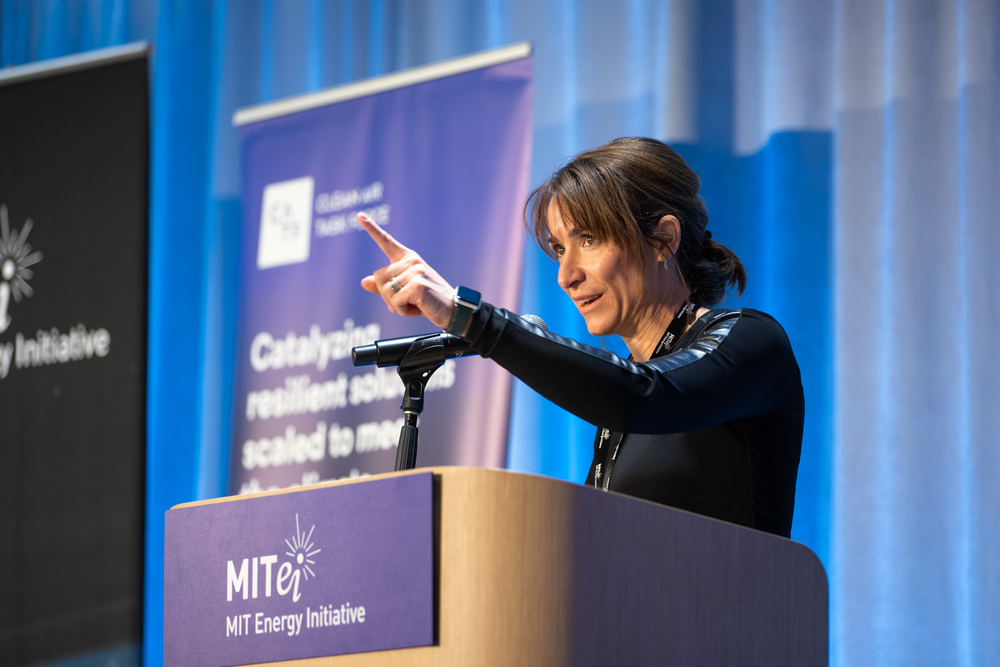
The geothermal industry is reaching a point where investments from corporate venture capitalists, investment bankers, and other mid-stage investors are needed if this energy source is going to meet its potential. Geothermal entrepreneurs, early-stage investors, and experts gathered with potential investors to emphasize this financial need at “GeoTech Summit: Accelerating geothermal technology, projects, and deal flow,” a gathering hosted by the MIT Energy Initiative (MITEI) and the Clean Air Task Force (CATF) on March 5, 2026.
“Geothermal is having a moment, and geothermal finance, specifically, is having a moment,” said Terra Rogers, the program director for CATF’s superhot rock team.
Experts pointed to increased support for geothermal energy exploration from the U.S. federal government that has survived the current presidential administration’s energy policy shifts. In addition, several geothermal startups, including Mazama Energy, Fervo Energy, and MITEI-spinout Quaise Energy have raised significant rounds of venture capital and have successfully demonstrated their next-generation technologies. Projections suggest that enhanced geothermal systems have a U.S. market potential of 85-110 gigawatts (GW) of installed power capacity in 2050, an increase from less than 1% of the United States’ capacity to about 3%, according to a McKinsey & Company report.
In January 2025, the U.S. Department of Energy’s (DOE) Advanced Research Projects Agency-Energy (ARPA-E) announced $30 million in funding to increase geothermal power production by unlocking superhot reservoirs deep within the earth. And last month the DOE announced an additional $171.5 million to support next-generation geothermal field-scale tests for both electricity generation and exploration drilling.
Even with these recent government investments in geothermal, those attending the GeoTech Summit noted that these numbers pale in comparison to previous government funding for other sources of energy. CATF officials cited Biden-era funding for large-scale demonstrations, manufacturing and supply chains, and supportive infrastructure for comparison. Allocations at the time were more than $9 billion for hydrogen and $10 billion for nuclear, according to the DOE’s March 2024 report, Pathways to Commercial Liftoff: Next-Generation Geothermal Power.
“The signal for support is strong, but the dollars are still a blip in terms of what we need to move this forward,” said CATF’s Rogers.
David Siap reinforced the role government financial support can play. Siap is a senior manager for energy with CREO Syndicate, a global nonprofit platform that helps asset owners and investors, such as family wealth offices, make high-impact investments to accelerate the shift to a low-carbon economy.
“Governmental support could absolutely transform the sector. The $171 million announcement—there needs to be more of that,” he said.
Still, current investors in geothermal tend to be early-stage venture capitalists, wealthy individuals, and family offices. The entrepreneurs and early-stage investors at the GeoTech Summit called for more investment from corporate venture capitalists, investment banks, and future customers of geothermal energy, or “off-takers,” to help the industry reach the next stage of growth.
There have been exceptions, however, and attendees at the GeoTech Summit saw those exceptions as positive signs for the future of geothermal funding and hoped they might be the start of a trend. Fervo Energy, a Houston-based company that is using oil and gas drilling expertise and technology to harness geothermal energy, recently closed its series E fundraising round of $462 million, bringing its total funding to $1.5 billion. Investors in this current round included venture capitalists, Google, and Liberty Mutual Investments. The diversity of funders and mix of equity, debt, and grant funding in Fervo’s successful efforts to raise capital since 2024 were seen as positive indicators for the industry.

Torsten Kolind, the co-founder of Underground Ventures, moderates a panel with Igor Kocis of GA Drilling, Moritz Pill of Borobotics, and Tony Pink of Mazama Energy, on what makes their geothermal technologies investment-worthy. Credit: Kelley Travers
“Thankfully, a lot of money is coming into this space [geothermal]. It’s really good to see it’s not just venture capital funding at this point. It’s other sources of funding—equity, debt, grant, and finance,” said Torsten Kolind, the co-founder of Underground Ventures, a venture capital firm that invests only in early-stage geothermal companies.
The geothermal industry is one where the early capital needs and resource risks are higher than many other generation technologies, but where significantly reduced risk and stable long-term returns once the project is operational. Currently, much of the investment is in developing technologies for identifying potential sites for geothermal plants and improving drilling capabilities. Venture capitalists tend to favor high-risk/high-return opportunities with smaller capital expenditures like these. Thus, investments that require high capital expenditures are more challenging for these investors, necessitating a broader pool of investors, experts in attendance said. This highlights the issues geothermal companies face: Once a geothermal energy source is found, the risk decreases significantly, but the cost increases dramatically. Then the investment is in building plants and digging wells.
“We’re probably talking about a hundred thousand or hundreds of thousands of wells, thousands of power plants. It’s an enormous exercise,” Kolind said of the investment needed to reach the International Energy Agency’s projected global market potential for next-generation geothermal of about 800 GW installed capacity by 2050.