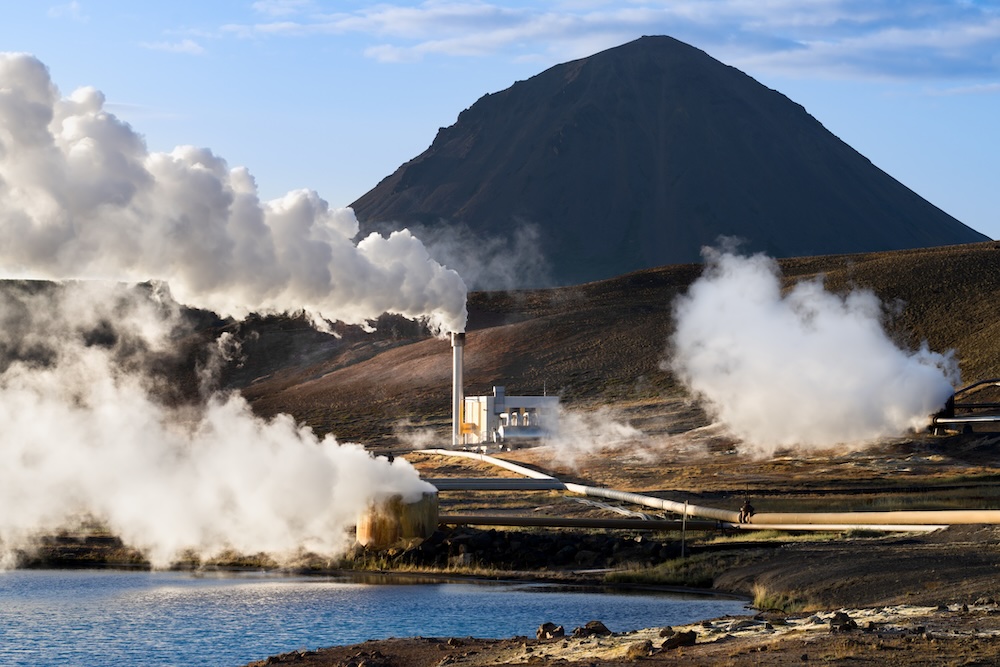
Geothermal energy, a clean, continuous energy source accessible in many locations, has been slow to catch on. Nearly 2,000 years ago, the Romans made extensive use of geothermal energy—heat from the Earth—including at the spa complex at present-day Bath, England. Electricity was first produced from geothermal sources in the early 1900s in Italy. In the United States, the Geysers field in California began generating electricity at scale in 1960 and routinely produces more than 725 megawatts of baseload power today. According to the International Energy Agency (IEA), geothermal energy still supplies less than 1% of global energy demand, although countries like Kenya (more than 40% of electricity generation) and Iceland (nearly 30% of electricity and 90% of the heating) have seen widespread adoption.
In recent years, technological advances, an influx of private capital, and shifting energy and environmental policies have driven renewed interest in expanding development of geothermal energy. If project costs continue to decline, the IEA predicts that geothermal energy could meet 15% of the growth in global electricity demand between 2024 and 2050. Many countries, including the United States, Indonesia, New Zealand, and Turkey, are prioritizing an expansion of geothermal energy as part of their broader energy strategies.
Achieving large-scale electricity generation from geothermal sources will depend on a significant expansion of so-called next-generation geothermal. This refers to tapping heat from source rocks at temperatures of 100ºC to more than 400ºC, often at depths of several kilometers below the surface. Just 10 days ago, U.S. Congressional Rep. Jake Auchincloss (D-MA) and Rep. Mark Amodei (R-NV) introduced bipartisan legislation to promote research, testing, and development of one type (superhot rock) of next-generation geothermal energy.
Geothermal energy at MIT
Through its leadership of the seminal 2006 The Future of Geothermal Energy report led by former MIT Professor Jeff Tester, MIT and the predecessor of the MIT Energy Initiative (MITEI) played an important role in national geothermal strategy two decades ago. In 2008, researchers at the Plasma Science Fusion Center (PSFC) invented millimeter-wave drilling with support from one of the first MITEI seed innovation grants. The technology, which could be particularly useful for geothermal installations in superhot and deep rock, is being commercialized by MIT spinout Quaise Energy.
The MIT Energy Initiative (MITEI) is sponsoring next-generation geothermal projects through its Future Energy Systems Center. A project led by MITEI Research Scientist Pablo Duenas-Martinez focuses on the techno-economics of electricity generation from a geothermal plant co-located with a data center, a timely topic given the proliferation of data center power purchase agreements for electricity generated by geothermal energy. MITEI’s March 4 Spring Symposium will focus on next-geothermal energy for the generation of firm power, and many of the leading exploration, drilling, reservoir development, and advanced technology companies working in this area will be sending panelists and speakers. On March 5, MITEI is collaborating with the Clean Air Task Force (CATF) to co-host the GeoTech Summit, which will explore accelerating technology development for and investment in next-generation geothermal.
To prepare for the upcoming symposium, MITEI organized a geothermal bootcamp during MIT’s Independent Activities Period (IAP) that introduced more than 40 members of the MIT community to geothermal basics, key technologies, and related MIT research. Carolyn Ruppel, MITEI’s deputy director of science and technology and the organizer of the IAP bootcamp and Spring Symposium, says, “MITEI’s member companies, which represent leading voices on energy, power generation, infrastructure, heavy industry, and digital technology, are increasingly approaching us about their interest in next-generation geothermal. There is also good momentum building across MIT, ranging from projects at the Earth Resources Laboratory to the millimeter-wave testbed being developed by PSFC and its MIT collaborators, individual projects in academic departments, and of course the work MITEI has been funding.”
Geothermal basics
Temperatures a few tens of meters below the ground are typically stable year-round. In some locations, these temperatures are warmer than the surface in winter and cooler in summer, making it possible to use geothermal heat pumps to moderate temperatures in buildings throughout the year. Overlooking the Charles River, Boston University’s 19-story Center for Computing and Data Science meets an estimated 90% of its heating and cooling needs using this kind of geothermal system. At the scale of large institutions or whole towns, thermal networks, district heating, and other approaches can efficiently supply heat from shallow geothermal sources without producing greenhouse gas emissions.
Tapping hotter and usually deeper geothermal sources could generate large amounts of electricity for decades at a single site. Next-generation geothermal is the term applied to these higher temperature systems developed using enhanced, advanced, and superhot technologies. Enhanced geothermal refers to circulating fluids through engineered fracture systems in deep, dry rock with relatively low native permeability. Advanced geothermal adopts a closed loop approach in which a working fluid is heated by circulating it through pipes embedded in the subsurface. Superhot geothermal, which is in its infancy, will likely use enhanced geothermal technology to circulate supercritical water through rock at almost 400ºC.
Next-generation geothermal
Drill deep enough and higher temperature resources are nearly ubiquitous beneath the continents, but early-stage development must focus on the most promising sites, where the methods and technologies to routinely reach these hotter rocks can be tested and refined. Locations like Iceland and the southwestern U.S. state of Nevada, where tectonic plates are separating or the Earth’s outer layer is thinning, have hotter temperatures closer to the surface than areas like the northeastern United States, where the Earth’s crust is old, thick, and cooler. Even in the southwestern United States, though, reaching the high temperatures required for generating electricity via geothermal systems will require routinely drilling to depths of greater than four kilometers in crystalline rock. This is significantly more challenging than drilling in the sedimentary basins that host most of the world’s oil and gas reserves.
For a location to be suitable for a next-generation geothermal installation requires not only heat, but also a fluid (usually water) to carry the heat. Water circulated through the rock formation to extract heat can be present naturally or brought from elsewhere and injected into the reservoir. This type of system also requires connected permeability such as an engineered fracture network oriented to prevent significant fluid losses and to channel fluid toward the extraction well. Closed loop (advanced) systems replace the freely circulating water with a working fluid that has favorable thermal characteristics and that is confined in piping.
Various geophysical methods are used to find sites with sufficient heat within a few kilometers of the surface, a prerequisite for their development as next-generation geothermal installations. Apart from direct measurements of temperatures in test boreholes, electrical resistivity and magnetotelluric surveys are among the most useful for inferring subsurface temperature regimes. Both techniques infer the electrical conductivity structure beneath the ground, permitting the identification of relatively warmer and more permeable rocks.
Drilling is often the most time-consuming and expensive part of preparing a site for a geothermal plant. This is particularly true for next-generation geothermal, where the targets can be deep or the system design may require large-scale horizontal drilling. Over the past few years, numerous innovations have increased drilling rates and attainable depths and temperatures and also lowered costs. Nonetheless, even with high-quality geophysical surveys, “You may spend $10 million on an exploratory well and find no heat,” says Andrew Inglis, the geothermal channel venture builder at MIT Proto Ventures.
Superhot geothermal, a next-generation geothermal approach that is advancing rapidly, presents special challenges. The metal drilling tools, the rocks in the formation, and circulating fluids all behave differently at temperatures of several hundred degrees, and standard practices, materials, and sensors must be significantly modified to tolerate the tough conditions. Once temperatures exceed 374ºC in a borehole even ~1 km deep, water reaches a supercritical state. This presents substantial advantages for extracting heat from the formation, but introduces the specter of rapid metal corrosion and precipitation of salts and silica that can quickly foul a borehole. Researchers are investigating substitution of supercritical carbon dioxide for water as a working fluid for superhot geothermal.
MIT innovations advancing next-generation geothermal
The millimeter-wave drilling technology invented at PSFC and being commercialized by Quaise Energy is the highest-profile next-generation geothermal innovation to emerge from MIT so far. Millimeter-wave technology uses microwave energy to vaporize rock and could prove to be several times faster than conventional drilling. PSFC and a multidisciplinary MIT team are devising a dedicated laboratory to study how millimeter-wave drilling interacts with crystalline rock at realistic pressure and temperature conditions and to test improvements to the existing technology. Steve Wukitch, interim director and principal research scientist at PSFC, notes that, “The facility we are building at MIT will allow us to test samples 500 times larger than is currently possible. This is an important step for investigating technologies that could unlock superhot geothermal energy.”
MIT Proto Ventures, which focuses on creating startups based on technology invented at MIT, currently hosts a dedicated geothermal energy channel led by Inglis. Since arriving at MIT in late 2024, Inglis has identified inventions and research that could advance next-generation geothermal from disciplines as disparate as mechanical and materials engineering, earth sciences, and chemistry. Examples of technologies originating with MIT researchers include sensors that measure micro-cracking in high-temperature rock, advanced metal alloys that could handle superhot fluids at a fraction of the cost of titanium, and anti-fouling coatings to protect pipes from the caustic geofluids common in hot, deep systems.
The MITEI Spring Symposium
At the upcoming MITEI Spring Symposium, these MIT innovators will introduce their technology to MITEI member companies in a session led by Inglis. Wukitch, who is moderating a panel on advanced drilling, will describe the planned millimeter-wave testbed, and Duenas-Martinez will lead a panel on power generation and storage. Terra Rogers, director for superhot rock geothermal energy at the CATF and the organizer of the joint CATF-MITEI GeoTech Summit on March 5, will lead a discussion of international and U.S. policies and the regulatory environment for expansion of next-generation geothermal. Poster presenters include MIT graduate students and researchers, MIT’s D-Lab, and the Geo@MIT geothermal-focused MIT student group, which was recognized with a 2024 bonus award by the U.S. Department of Energy’s Geothermal Technologies Office in the nationwide EnergyTech University Prize competition.