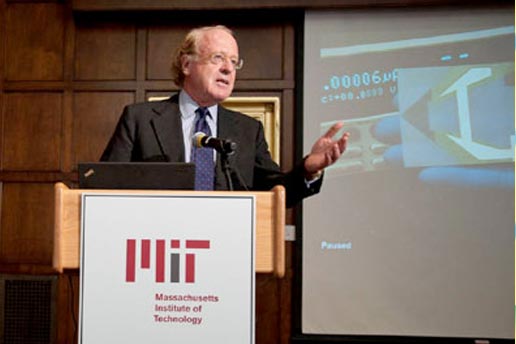
New MIT innovations such as imprinting solar cells on paper and a material that could help clean up oil spills were unveiled Oct. 18 at a briefing led by MIT President Susan Hockfield and Paolo Scaroni, CEO of the Italian energy company Eni SpA.
The event highlighted new joint technologies coming out of the Eni-MIT Alliance. Eni is a founding member of the MIT Energy Initiative (MITEI). Established in 2008, the Eni-MIT Alliance focuses on research projects designed to enhance critical components of Eni’s core business, including oil and gas production; and on the Eni-MIT Solar Frontiers Center, which supports the development of advanced solar energy technologies.
Hockfield credited Eni with “making far-sighted investments that could transform the long-term energy equation,” and noted that the alliance has resulted in 18 published studies and five patent filings to date.
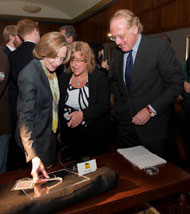
Karen Gleason, Associate Dean of Engineering for Research, reported that an interdisciplinary research team has created a revolutionary way to produce ultra-lightweight, inexpensive, flexible solar cells. She demonstrated how an index card-sized square of ordinary tracing paper imprinted with these cells could power an LED clock.
“This paper puts out on order of 20 volts. We have similar cells that put out 50 volts,” said Gleason, Alexander and I. Michael Kasser Professor of Chemical Engineering. “You really can make solar cells on paper that are usable and that power a device.”
Gleason’s approach involves rapidly depositing materials at room temperature using only environmentally friendly methods. “These features render this class of surface modification compatible with virtually any substrate,” she said. Using the same method of depositing thin films of organic and inorganic materials, solar cells could be layered on roof tiles, window blinds or laptops.
Philip M. Gschwend, Professor of Engineering, presented a nanotech-based absorbent material that hates water but soaks up oil. “It’s possible we can create devices that, when oil is escaping, can recapture the oil and keep it in one place. It can then be taken out of the water and put in a tanker,” he said.
He showed a video of a cone of the material submerged in a beaker of oil and water simulating an oil spill. Oil pooled in the device and was removed with no water in the mixture. Gschwend said such oil-collecting devices, made flexible and strong enough to withstand hurricanes and other aspects of the harsh marine environment, may one day be deployed permanently on buoys in areas such as the Gulf of Mexico as preventative measures against future spills.
Scaroni said he was impressed with MIT’s research results and emphasized the urgency of making products such as Gschwend’s oil-collecting device available to address catastrophes such as the BP spill in the Gulf of Mexico. Before the accident, companies such as Eni considered such incidents close to impossible. “The fact is today we cannot say that anymore. It has pushed us to work in two fields—prevention and solutions–to provide answers to what happens if have an accident,” he said.
Both researchers predicted that their technologies could make it to the marketplace in five years.