About 200 MIT students learned about today’s energy challenges through activities and courses either run by or financially supported by the MIT Energy Initiative (MITEI) during the 2026 Independent Activities Period (IAP). More than 320 others from the MIT community and beyond also participated in those IAP courses.
The MITEI-supported courses and field trips included opportunities for participants to use mathematical modeling to accommodate energy demand from data centers, learn about the fundamentals of geothermal energy, and gain deeper understanding of alternatives to carbon-emitting industrial food systems in Spain.
MITEI supported nine activities and courses in total during IAP, including the five-session hands-on modeling energy systems course, the full-day geothermal bootcamp, and the 18-day immersive course on regenerative agriculture and economies in Catalunya, Spain. Besides the student trip to Spain, MITEI also supported student trips to Argentina, Cameroon, and Ghana.
“IAP is a special time for the MIT community to explore new interests and experiences. The IAP courses that MITEI teaches and sponsors introduce energy topics to both students and staff. And the activities that we fund in the U.S. and overseas expose students to real-world energy projects,” said William H. Green, director of MITEI, and the Hoyt C. Hottel Professor of Chemical Engineering.
Each year MITEI, through its education program, offers or supports IAP courses and field trips related to the energy transition. This year, MITEI organized three courses, and financially supported six other activities and courses run by departments and centers across MIT. Those courses and trips were run by the Department of Nuclear Science and Engineering, the Department of Urban Studies and Planning, the Program for Science, Technology, and Society, the MIT Sloan Sustainability Initiative, and the MIT D-Lab.
The MITEI course Modeling Energy Systems for a Data-Driven Future attracted Leila Hudson, a second-year PhD student in the Department of Electrical Engineering and Computer Science, because she recently shifted her research focus from photonics to power grid optimization. The course, which now has been offered for 17 years, gave her an introduction into mathematical modeling that broadened her thinking about the model she is working on. Hudson is creating a model for power grid expansion, in part to deal with the increased demand for electricity for data centers being used for artificial intelligence.
“The largest takeaway was just that there are many more expansion models out there that I didn’t even really think about. It was interesting to see how the others built their models, what they included in their models, which variables, which types of renewable energies,” she said. “I’m taking into consideration solar, hydro, wind, and geothermal, because those are the four biggest ones. Some presenters were also modeling hydrogen as storage or a decarbonized fuel pathway. While it is not one of the dominant electricity generation sources today, it could play an important role in long-term system flexibility. Maybe I should consider that in my model at a later stage.”
Kate Zappa traveled to Ghana as a follow-up to the D-Lab Development class she took in the fall. The Ghana trip, as well as other students’ trips to Cameroon and Argentina, were co-sponsored by MITEI and D-Lab. In the fall class Zappa took, the students were exploring ways to make the harvesting of invasive plants like water hyacinth easier. During her trip to Ghana, Zappa worked with other students and members of the local community to improve the harvesting of the plants, process them, and turn the dried and milled plants into biofuel to replace charcoal for cooking.
Zappa, a junior studying mechanical engineering, and her team were responsible for creating a manual hydraulic press that could be used to create briquettes for cooking, as electricity is costly in this region and using it to make briquets risked it not being available for other needs.
“The community we were working with had electricity, but not enough to use it for making briquettes. And we wanted to make something simple, that would work and could be used now,” Zappa said.
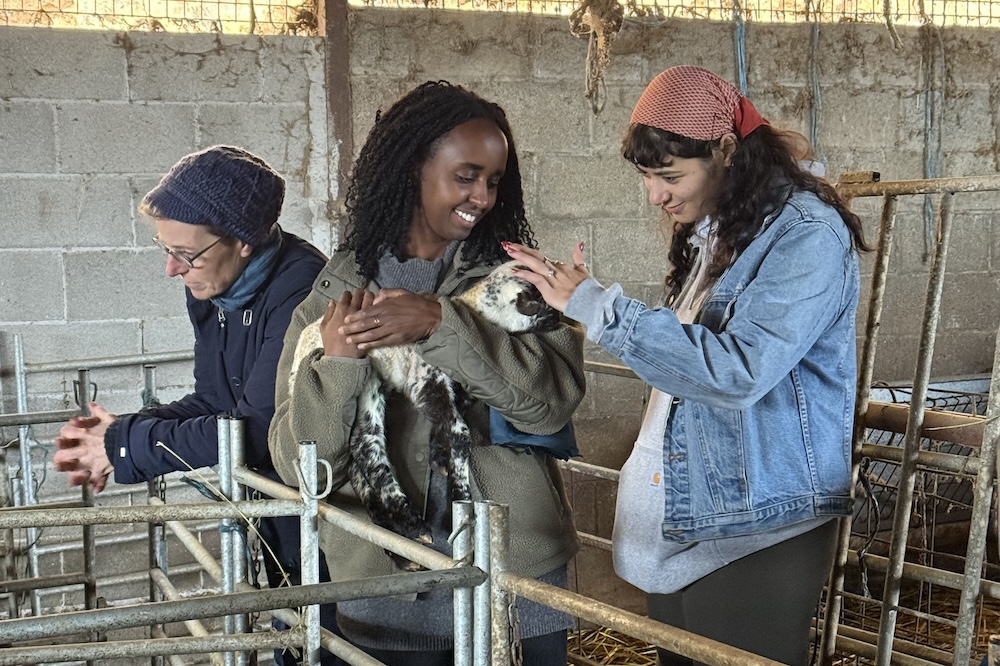
Aisha Hasan and Yara Eliyan pet a two-hour-old lamb in Catalunya, Spain, as part of Professor Kate Brown’s (background) IAP course How to Grow Resilient Futures: Regenerative Agriculture and Economies. Photo: Alicia Goldstein Raun
Sara Akasha, a junior studying chemical engineering, spent almost three weeks in Spain learning about methods of sustainable agriculture on a trip co-sponsored by MITEI and MIT International Science and Technology Initiatives (MISTI). Akasha is from the United Arab Emirates, a country that imports much of its food and she was interested in learning more about agricultural technology.
Akasha and the other MIT students visited an organic pig farm that reduced the amount of energy used and carbon produced in raising livestock by relying on its own pig manure for fertilizer, using a local slaughterhouse, and distributing its meat to local communities. “The travel costs and energy that go into transportation—they completely cut that out,” Akasha said. During that visit, Akasha learned about the significant effect raising livestock has on climate.
“I had no idea how much of an impact animal agriculture has on the climate. I don’t think many people are aware of the impact raising cows, and the methane they produce, can have on the atmosphere,” she said, adding that she has since become vegetarian and is much more conscious of her overall consumption of goods and tries to minimize waste.
In addition to supporting IAP courses and activities, MITEI also supports undergraduate students through the Energy Undergraduate Research Opportunities Program each fall, IAP period, spring, and summer; and supports graduate students’ research through the Society of Energy Scholars.
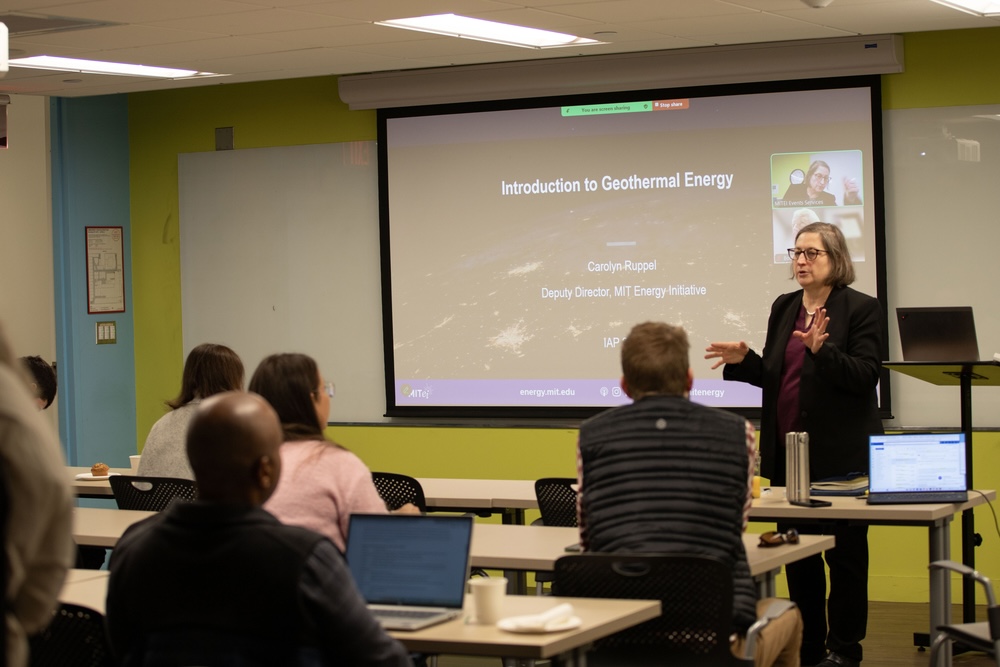
MITEI Deputy Director Carolyn Ruppel presents an introduction to geothermal energy during MITEI’s IAP bootcamp Geothermal Energy Fundamentals. Photo: Charlotte Whittle
The MITEI-organized IAP activities this year were:
- Modeling Energy Systems for a Data-Driven Future, a hands-on course that explored how mathematical modeling can inform and accelerate the transition toward net-zero emissions targets. The course had 45 participants and instructors included Pablo Duenas-Martinez, a research scientist at MITEI; Deep Deka, program manager for MITEI’s Data Center Power Forum; and Ruaridh McDonald, MITEI’s energy systems research lead.
- Geothermal Energy Fundamentals: This IAP bootcamp covered the fundamentals of geothermal energy, including key technologies, technical and economic feasibility, the startup/investment space, and policy considerations. The bootcamp had 40 participants and also included an introduction to MIT’s geothermal activities, research, and innovations. Instructors included MITEI Deputy Director Carolyn Ruppel; Spiros Gkousis, postdoctoral student at MITEI; and Andrew Inglis, a venture builder at MIT Proto Ventures.
- Sustainable AI, an exploration of the climate harms, potential climate benefits, and climate impact of AI, and strategies for making AI more sustainable. The course was taught by MIT lecturer Jenn Turliuk, and offered in collaboration with the MIT Sloan Sustainability Initiative.
The MITEI-supported IAP activities run by other MIT departments and centers were:
- How to Grow Resilient Futures: Regenerative Agriculture and Economies in Catalunya, Spain, a look at the ecological and economic alternatives to industrial food systems. The course was taught by Kate Brown, professor in the program in science, technology, and society, and offered in collaboration with MISTI.
- Renewable Energy Facility Siting Clinic, an opportunity to work with frontline communities on renewable siting negotiations. The clinic was run by Jungwoo Chun, a lecturer in climate, sustainability, and negotiation and Larry Susskind, professor, in the Department of Urban Studies and Planning.
- Energy Policy and Planning in Process, an introduction to renewable energy policy and planning through discussion and field-based explorations, including visits to wind/solar production sites, green building design projects, and community geothermal installations. The course was taught by Ezra Glenn, lecturer in housing and urban history in the Department of Urban Studies and Planning.
- Energy Facilities Field Trips, visits to Millstone Nuclear Power Station and Northfield Mountain hydroelectricity facility. The lead instructor was Michael Short, professor, in the Department of Nuclear Science and Engineering.
- Applications of Energy in Global Development, field trips to Argentina, to study weatherization for low-income households, Cameroon, to learn about locally manufactured and energy-efficient building materials, and Ghana, to learn about transforming invasive aquatic weeds into household and industrial fuels. Dan Sweeney, a research scientist and lecturer with D-Lab, was the instructor.
- Intro to Thermal Energy Networks with Field Trips, a technical introduction to campus/district building decarbonization using fifth and sixth generation thermal energy networks. The instructor was Susan Murcott, a D-Lab lecturer.