
An MIT analysis of seven climate-change bills now being considered by Congress shows that adopting any of them would cut the nation’s greenhouse gas (GHG) emissions significantly from a business-as-usual trajectory. The analysis includes additional positive news: the costs to the economy of even the most stringent bill would not substantially dampen economic growth over the five decades covered by the analysis.
On the more challenging side, the US energy mix would change dramatically by 2050, moving from today’s reliance on high-carbon energy sources to expanded use of biofuels and new nuclear or low-carbon coal-fired power plants. In addition, the analysis indicates that the positive impact of any US action on global temperature would be overwhelmed by the emissions behavior of the rest of the world.
“As a result, a primary consideration in choosing US emissions targets should be their value in leading other major countries to take on similar efforts,” said Henry D. Jacoby, professor of management and co-director of the MIT Joint Program on the Science and Policy of Global Change.
Modeling costs and impacts
While the Congressional approaches now being proposed vary in a number of ways, a key difference among them is how strictly they would limit emissions of carbon dioxide and other GHGs. Several bills would stabilize US emissions near current levels, while others call for emissions reductions of 50 to 80 percent below the 1990 level by 2050.
How would meeting these various emissions targets affect future global climate, and what would be the cost to the US economy?
To examine those questions, Jacoby, John M. Reilly, the joint program’s associate director for research, chief economic modeler Sergey Paltsev, and their colleagues used their Integrated Global System Model (IGSM). This model projects global environmental changes that may result from human activities and the effect of proposed policies on such changes, qualified by the uncertainties associated with the projections. Within the IGSM, the Emissions Prediction and Policy Analysis (EPPA) model tracks US economic activity and GHG emissions, including the effects of specified emissions-abatement policies.
In comparing the Congressional bills, the researchers focused on one feature common to most of them: establishment of a cap-and-trade system to limit emissions. Under such a system, the government would establish a national emissions target for a certain period of time and distribute emissions permits, or “allowances,” to meet that target. Each major emitter would receive a limited number of allowances. If one company exceeded its allowances, it could buy allowances from another company that had come in under its limit.
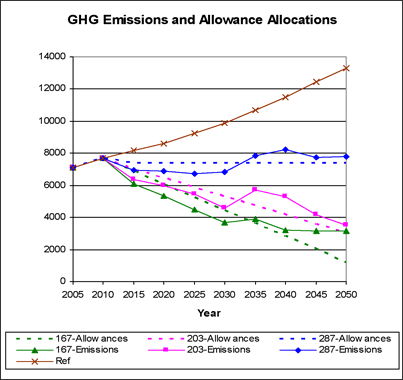
Total emissions—and therefore total number of allowances—are set by the various Congressional bills, in most cases for the period from 2012 to 2050. The seven bills (Bingaman-Specter [draft], Waxman, Feinstein, Sanders-Boxer, Lieberman-McCain, Udall-Petri, Kerry-Snowe) cluster around three levels of cumulative allowances for GHG emissions (measured in terms of carbon dioxide equivalents): 287 billion metric tons (bmt), 203 bmt, and 167 bmt.
Analytical results
Using their model, the researchers analyzed various impacts based on those representative levels of allowances. The results show that all of the bills would reduce GHG emissions in the US well below the doubling that the model predicts will occur by 2050 if no action is taken. The more ambitious proposals could limit global temperature rise by 2100 to about 2 degrees C above current levels—about half the projected rise if no action is taken—but only if other nations, including developing nations, also strongly control their GHG emissions.
Under the more stringent bills, the estimated cost of meeting the target could be a 1.5 to 2 percent decline in the average economic well-being of US consumers. The price of traded allowances would be between $30 and $55 per ton of carbon dioxide (and other GHGs) in 2015, rising to as much as $200 by 2050 (in constant dollars). Allowances could be distributed for free, or they could be auctioned, with the resulting government revenue—some $100 to $500 billion—recycled back into the economy in some way.
While the cost to the US economy would be relatively small, the transformation of the US energy system by 2050 would be dramatic. The change is illustrated by sample results from the middle assumption—230 bmt, or emissions at 50% below 1990 levels in 2050.
For example, even with strong growth in renewable electricity generation, 500 or more new no- or low-carbon power plants would be needed by 2050. They can be coal-fired plants with carbon capture and storage (CCS), a technology now under development (assumed in the model to capture 90 percent of a plant’s carbon emissions). Or they can be nuclear power plants—a major construction undertaking, given that the US now has a total of just over 100 operating nuclear plants and has not started a new one in several decades.
Significant quantities of biofuel are used to replace fossil sources of transportation fuel. Even assuming large-scale use of efficient cellulosic-conversion technology, growing the necessary feedstock domestically requires about 500 million acres of land—more than the total current US cropland. Alternatively, the US can buy biofuel on international markets, once again becoming a major importer of fuels.
In terms of changes in energy use, the middle-level restriction slows the growth of demand between 2005 and 2050, and the mix of primary energy sources used changes considerably. Coal use declines until about 2025, with natural gas playing a major role in emissions mitigation in the mid-term. (Nuclear power is held steady in this analysis.) Around 2025, coal-fired generation with CCS becomes economically viable, and coal use begins to expand again.
Biofuel use grows and oil use declines until about 2030, when (under the model assumptions) developing countries tighten their emissions restrictions. As a result, worldwide demand shifts from oil to biofuel, causing oil price to drop and biofuel price to rise.
Broader implications
The researchers stress that such results represent just one plausible scenario of potential outcomes. Their value is not in the precise numerical estimates but in the general insights provided.
For example, they demonstrate the enormous scale of the climate-change problem and the critical roles to be played by natural gas, nuclear, and low-carbon coal-fired power generation as emissions constraints tighten over time. They also show the vulnerability of the coal industry: Without CCS technology, coal is not a viable source of power. Such findings underscore the results of MIT’s major studies of nuclear power and coal (web.mit.edu/nuclearpower and web.mit.edu/coal). Both studies recommend specific steps that the United States should take to keep those sources of energy viable. The coal study cites the urgent need for large-scale demonstration of CCS to get that technology ready for widespread deployment in the 2020 to 2025 timeframe.
The predicted huge expansion of biofuel production raises an issue that is sometimes overlooked: Converting vast areas of land from other crops, grassland, or forest to biofuel would lead to a significant release of carbon dioxide from soils and vegetation. “Emissions from changes in land use aren’t typically included in cap-and-trade proposals,” said Reilly. “If emissions credits are to be given for using biofuel, charges must be allocated for any emissions associated with producing it, whether it’s produced in the US or elsewhere.”
Finally, the results emphasize the importance of taking a global perspective when considering climate-change policies. International trade has a significant impact on the cost and effects of climate actions taken by any country. More important, reducing the risk of climate change cannot be accomplished by any one country. “Our results confirm the well-known fact of global climate change: meeting temperature or concentration goals requires concerted efforts from much of the world over a substantial period of time,” said Jacoby.
Development of the IGSM and EPPA models and their application to these Congressional bills were supported by a group of US government agencies, a coalition of industrial sponsors, and one foundation.