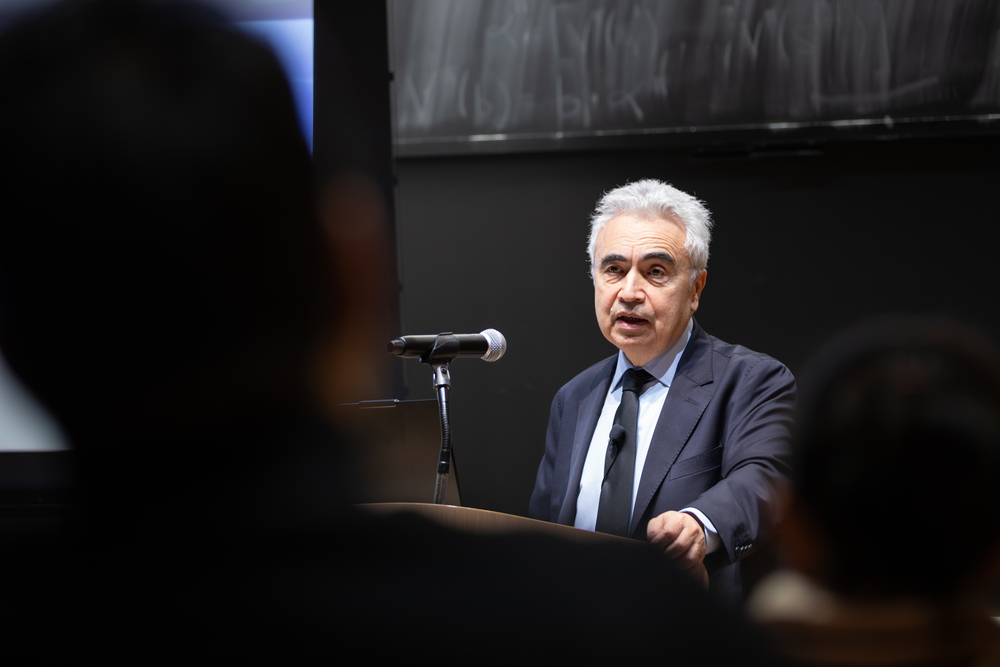
One day after the announcement of a ceasefire between the United States and Iran, the head of the International Energy Agency (IEA) outlined the implications of the war in the Middle East on the global energy system and the world’s economy, offering his expertise to an MIT audience.
“This is the largest energy crisis we’ve ever had in the world,” Fatih Birol, the executive director of the IEA, said at the MIT Energy Initiative’s (MITEI) Earth Day Colloquium on April 8. Birol put the current disruption of the world’s energy markets into historical perspective, shared what he believes will be the long-term impacts of this war—even in the best-case scenario where the ceasefire paves a path towards peace—and emphasized the need to create a more sustainable, resilient system moving forward.
In 1973 and again in 1979, there were oil crises that led the world economy into recession, with many countries—especially those with developing economies—spiraling into debt. More recently, Russia’s invasion of Ukraine led to a natural gas crisis. “The current crisis, the amounts of oil and gas we’ve lost, is bigger than all those three put together,” Birol stated. According to data received two hours before the seminar, Birol confirmed that 80 energy facilities in the Middle East had been damaged, with over one-third of those having been severely damaged.
The IEA has played a significant role in the global response to the war. “Our job is to have a real-world impact,” said Birol. Earlier in the conflict, after making clear to policy makers and members of the press the scale of the problem at hand, the IEA turned to its member countries—which are required to have significant oil stock reserves—to bring their reserves to the market. “Since the disruption was so big, we brought all the countries together, which is not easy,” Birol said. “We released 400 million barrels of oil, which is the highest we have ever done. This calmed markets and put downward pressure on prices.” The IEA also released a suite of recommendations for conserving oil quickly, many of which countries around the world are already implementing, said Birol.
The implications of this crisis are far reaching and will vary in severity depending on how long the war lasts and how quickly normal operations resume afterwards—which could take some time considering the extent of the damage to the Middle East’s energy infrastructure, Birol said.
Birol explained the more immediate impacts of the war on the gas industry. Though the natural gas industry has presented itself as a reliable, affordable, and flexible energy source, Birol highlighted that the two major gas crises in the last four years have brought that assertion into question.
“Is [natural gas] still reliable? Is it still flexible? Is it still affordable? After these two big crises, the natural gas industry needs to work hard to regain its brand,” he said.
Birol also outlined three potential outcomes that this shift may bring to the renewable energy sector. First, there is historical precedent for building up nuclear power plants in response to the oil crises of the 1970s. “Around 45% of nuclear power plants operating today were built as a response to those crises,” said Birol. He believes there will be another large push for nuclear power, including small nuclear reactors.
Second, renewables may be the biggest beneficiaries of this situation, he said. “In Europe, after Russia’s invasion of Ukraine, the renewable annual installations increased by a factor of three,” he said.
Third, especially in Asia, we will likely see an increase in the market penetration of electric vehicles, Birol said. This is especially important to note because Asia is the center of current oil demand growth, but the adoption of more electric vehicles could have an impact on that, he suggested. Previous crises have also led to car manufacturers improving the fuel efficiency of their cars.
“The energy security premium will be a factor of the energy trade in the future, in addition to the cost of energy,” said Birol, speaking to the longer-term effects on the global energy market. “Countries will be more careful now with whom they are trading.”
Addressing the current crisis also necessitates changes to our energy system going forward, according to Birol. He explained that the entire global economy is being held hostage by the 50 kilometers of the Strait of Hormuz, which is a critical path not only for oil and gas shipments, but for materials used to make fertilizer, which are needed to feed the world’s population, and materials such as helium, which are needed to manufacture products like cell phones.
“I’m afraid that after this is finished, some of the countries will come back faster because they have stronger financial muscles, better engineering capabilities, and better technologies, whereas other countries will suffer,” he said. “It will be, in my view, not easy for the global economy. I believe who will be suffering under this economic damage will be mainly developing countries.”
The burden on developing countries will not only come in the form of energy prices, but also lasting impacts on fertilizer consumption, food security, and food prices, which Birol emphasized is a global problem. “What should be the response to have a more secure, but also more sustainable, future for everybody?” he asked.
Birol suggested the best possible outcome to the current global energy and economic disruption would be if the ceasefire leads to a peaceful settlement of the war. Still, this “best possible outcome” includes significant risk for much of the world.
If there is a settlement of peace, Birol said he expects oil and the gas production in the region to restart. He noted that there are about 200 fully laden oil tankers and 15 loaded LNG ships that could leave the Gulf fairly quickly if the Strait of Hormuz fully reopens.
“But I don’t think that in a very short period of time we will go back where we were before the war,” Birol said. “And this may keep the prices at elevated levels. This is surely not good news, especially in the emerging world. I would be surprised if we don’t see significant inflationary pressures in Asian developing countries, in Africa, and in Latin America,” Birol said. “In addition to that, the petrochemical industry, fertilizers, we will discover how important those commodities are for the supply chains we have…I expect a bit of volatility in the markets.”
The Colloquium is part of the ongoing MITEI Presents: Advancing the Energy Transition speaker series, which highlights energy experts and leaders at the forefront of the scientific, technological, and policy solutions needed to transform our energy systems. The series will resume in Fall 2026. For more information on this and additional events, visit: energy.mit.edu/events