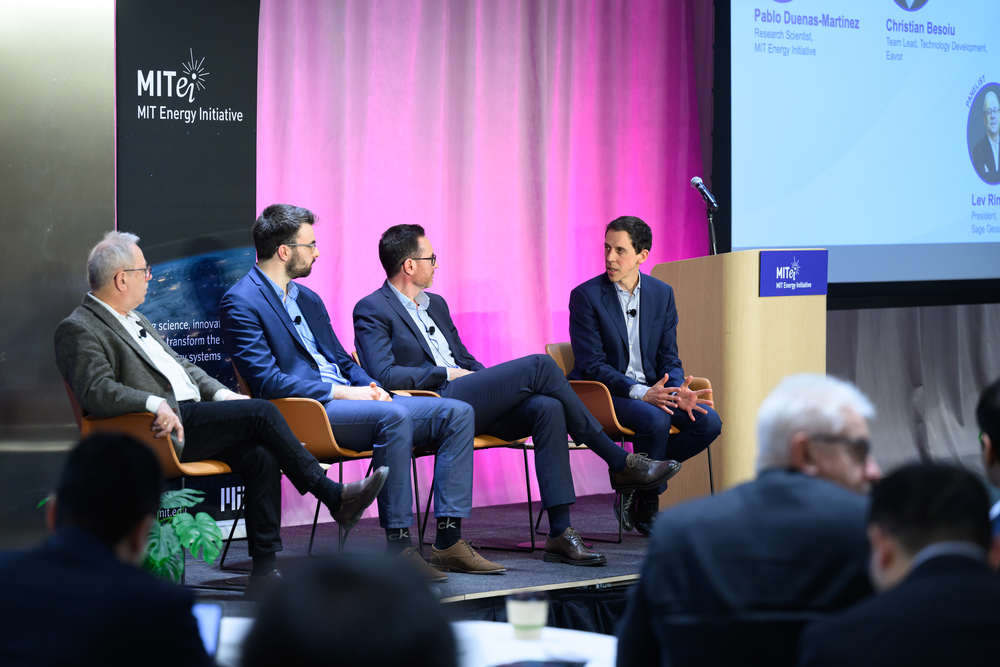
Drill deep and drill differently. That’s what’s needed to exploit the nearly bottomless promise of geothermal energy in the United States and around the globe, according to participants at the 2026 Spring Symposium, titled “Next-generation geothermal energy for firm power.” Sponsored by the MIT Energy Initiative (MITEI), the March 4th event drew 120 people, including MIT faculty and students, investors, and representatives from startups, multinational energy companies, and zero-carbon advocacy groups.
“The time feels right to pull together good policy, great corporate partners, and the research and technological innovations…to make significant advances in the widespread utilization of this incredible resource,” said Karen Knutson, the vice president for government affairs at MIT, welcoming attendees.
Technology from the oil and gas industry helped usher in a first wave of geothermal energy. But chewing vertical holes through rocks in traditional ways can’t deliver on the full potential of this resource. And the real treasure—geologic formations radiating heat at 374°C and above—lies kilometers beneath Earth’s surface, far beyond the reach of most conventional drilling rigs.
Panelists explored the many innovations in accessing and circulating subsurface heat, as well as digging to unprecedented depths through extremely challenging geological conditions, discussing advanced drilling technologies, materials, and subsurface imaging.
This work is needed urgently, as demand for firm (always on) power skyrockets in response to the electrification of industry and rise of data centers, said Pablo Dueñas Martínez, a MITEI research scientist. “We cannot get through this only with solar and wind; we need dense, deployable energy like geothermal.”
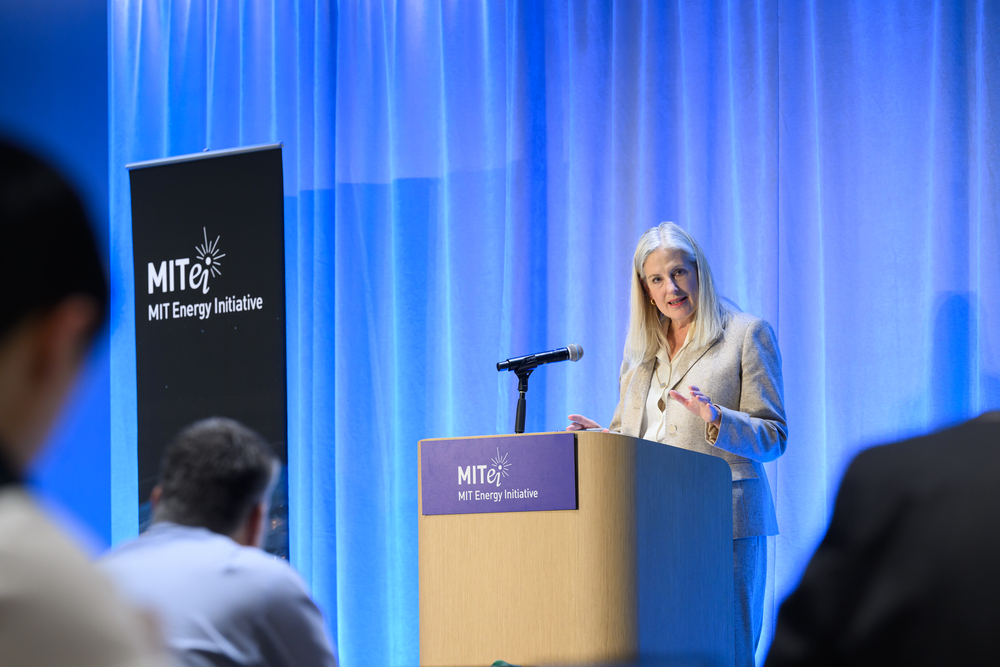
Karen Knutson, MIT’s vice president for government affairs, gave the welcome address at the MITEI’s Spring Symposium, at which experts gathered to explore opportunities for next-generation geothermal for firm power. Credit: Gretchen Ertl
From “minuscule” to “almost inexhaustible” energy
In her opening remarks, Carolyn Ruppel, MITEI’s deputy director of science and technology, noted that despite decades of successful projects in places like the United States, Kenya, Iceland, Indonesia, and Turkey, geothermal still contributes only a “minuscule” share of global electricity. “The tremendous heat beneath our feet remains largely untouched,” she said.
Citing ’s milestone 2006 study The Future of Geothermal Energy, keynote speaker John McLennan, a professor at the University of Utah and co–principal investigator of the U.S. Department of Energy’s Utah FORGE enhanced geothermal systems (EGS) field laboratory, reminded attendees that the continental crust holds enough accessible heat to supply power for generations. “For practical purposes, it’s almost inexhaustible,” he said.
The question now, he said, is how to access that resource economically and responsibly.
At the Utah FORGE test site, McLennan has been part of a team investigating one method—adapting the oil and gas industry’s drilling and reservoir engineering expertise for hot, relatively impermeable rocks.
The project has drilled multiple deep wells into crystalline granitic rock, including a pair of wells that have been hydraulically stimulated and connected. In a recent circulation test, cold water was pumped down one well, flowed through fractures, and returned hot through the other.
“On a commercial basis…this hot water would be converted to electricity at the surface,” McLennan said. “This has now been demonstrated at Utah FORGE.”
The basic physics, in other words, work. The harder problems now are cost, repeatability, and scale.
Geothermal on the grid
Several panels highlighted the fact that next-generation geothermal is already beginning to deliver firm power.
At Lightning Dock, New Mexico, geothermal company Zanskar used a probabilistic modeling framework that simulated thousands of possible subsurface configurations to identify where to drill a new production well at an underperforming geothermal field. By thermal power delivered, the resulting well is now “the most productive pumped geothermal well in the country,” said Joel Edwards, Zanskar’s co-founder and chief technology officer—powering the entire15 megawatt (MW) Lightning Dock plant from a single well.
This data-driven approach enables the company to find and develop new resources faster and more cheaply than traditional methods, said Edwards.
José Bona, the director of next-generation geothermal at Turboden, explained how his company’s technology uses specialized turbines to circulate organic fluids that conserve heat better than water, and then convert that heat efficiently into electrical power. This closed-cycle technology can utilize low- to medium-temperature heat sources. Turboden is supplying its technology both to the Lightning Dock geothermal facility in New Mexico and to Fervo Energy’s Cape Station in southwest Utah, an EGS project that will begin delivering 100 MW of baseload, clean electricity to the grid this year, aiming for 500 MW by 2028.
In Geretsried, Germany, Eavor has developed its own proprietary closed-loop system by creating a kind of underground radiator.
“We drilled to about 4.5 kilometers vertical depth, completed six horizontal multilateral pairs, and we delivered the first power to the grid in December,” said Christian Besoiu, the team lead of technology development at Eavor. The project will ultimately be capable of supplying 8.2 MW of electricity to the 32,000 households in the Bavarian town of Geretsried and 64 MW of thermal energy to the district in which the town lies, prioritizing heat when needed.
Beyond oil and gas technology
Early geothermal exploration typically targeted pre-existing faults using vertical wells left by oil and gas drilling. Today, companies are experimenting with rock fracturing at multiple subsurface levels and creating heat reservoirs in previously untenable formations by using propping materials.
“Instead of vertical wells, we’re going to horizontal wells, we’re going to cased wells, we’re introducing [solid materials that hold open hydraulically fractured rock]…we do dozens of stages with these designs,” said Koenraad Beckers, the geothermal engineering lead at ResFrac. This shale-style approach has already yielded much higher flow rates and more reliable performance than earlier EGS.
Some current geothermal wells manage to achieve depths close to 15,000 feet using the oil and gas industry’s polycrystalline diamond compact drill bits, which can bore through hard rock like granite at more than 100 feet per hour. But these bits and the rigs that drive them are no match for conditions six or more kilometers down—and it is at those depths that the heat on hand begins to make an overwhelming economic case for geothermal.
“If we go to around 300 to 350 degrees, your power potential increases 10 times,” said Lev Ring, CEO of Sage Geosystems. “At that point, with reasonable CAPEX assumptions, [a metric for comparing the cost of electricity across different generation technologies] is around four cents, and geothermal becomes cheaper than any other alternative.”
But “at 10 kilometers down…the largest land rigs in existence today cannot handle it,” Ring added. “We need alternatives—new materials, new ways to handle pressure, maybe even welding on the rig…a whole space that has not been addressed yet.”
One panel, featuring Quaise Energy, an MIT spinout with MITEI roots, spotlighted just how radically drilling might change. Co-founder Matt Houde described the company’s millimeter-wave drilling approach, which uses high-frequency electromagnetic waves derived from fusion research to vaporize rock instead of grinding it, as with conventional drilling. In a recent Texas field test, the team drilled 100 meters of hard basement rock in about a month and is now planning kilometer-scale trials aimed at reaching superhot rock temperatures around 400°C, where each well could deliver many times the power of today’s geothermal projects.
Innovations for deep drilling
Moderating a panel on “MIT innovations for next-generation geothermal,” Andrew Inglis, the venture builder in residence with MIT Proto Ventures, whose position is sponsored by the U.S. Department of Energy GEODE program, framed the Institute’s role in getting such hard-tech ideas out of the lab and into the field. “The way MIT thinks about tech development, uniquely from other universities, can play a very singular role in geothermal commercial lift-off,” he said.
Materials researchers on that panel illustrated the point. Matěj Peč, an associate professor of geophysics in the Department of Earth, Atmospheric and Planetary Sciences, outlined work to build sensors that survive up to 900°C so that rock deformation and fracturing can be studied at supercritical conditions. Michael Short, the Class of 1941 Professor in the Department of Nuclear Science and Engineering, and C. Cem Tasan, the POSCO Associate Professor of Metallurgy in the Department of Materials Science and Engineering, respectively described coatings and alloys designed to resist corrosion, fouling, and cracking in extreme environments. In response to audience questions after their talks, Tasan made an important point, highlighting how academics need input from industry to understand the real-world problems (e.g., corrosion of pipes by geofluids) that require engineering solutions.
Other researchers are rethinking how to detect geothermal resources: Wanju Yuan, a research scientist with the Geological Survey of Canada at Natural Resources Canada, is using satellite imagery and thermal infrared sensing to screen vast regions for subtle hot spots and structures, processing thousands of images to identify promising sites in just a few months of work. “It’s a very efficient way to screen potential areas before more expensive exploration, thus reducing exploration and drilling risks,” he said.
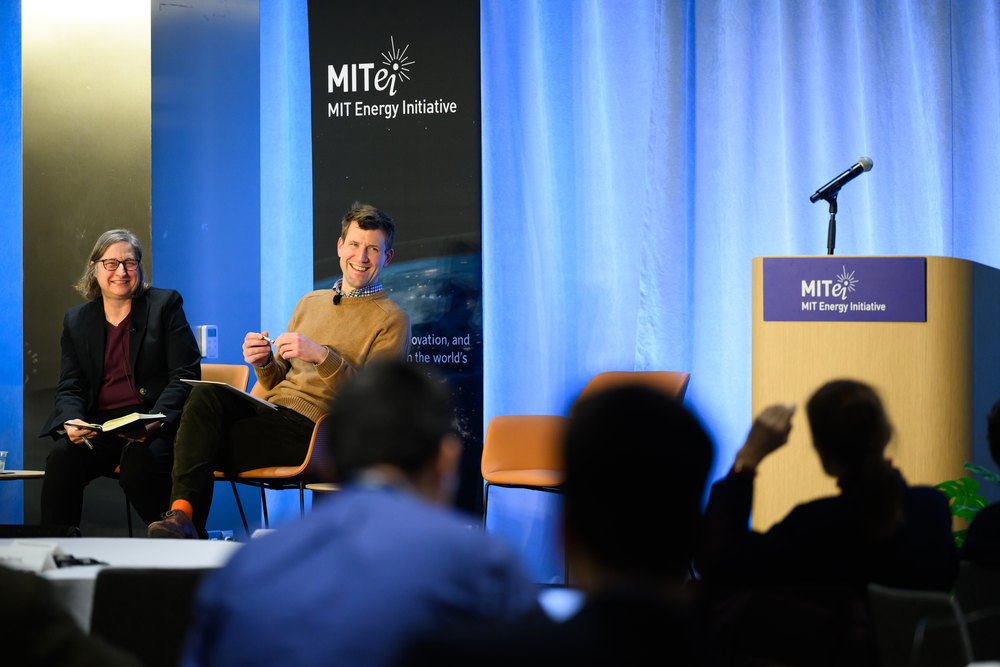
Carolyn Ruppel, MITEI deputy director of science and technology, and Andrew Inglis, the venture builder in residence with MIT Proto Ventures, wrap up the day-long conference following a series of discussions ranging from accessing geothermal resources to avenues for sparking investment in it. Credit: Gretchen Ertl
Policy as backdrop, not center stage
Policy loomed in the background of many discussions—from bipartisan support for geothermal exploration and tax incentives, to issues of regulation and permitting.
For Ruppel, that was by design.
“We wanted this meeting to showcase what’s technically possible and what’s already happening on the ground,” she said. “The policy world is starting to pay attention. Our job is to make sure that when that spotlight turns our way, next-generation geothermal is ready.”
MITEI’s Spring Symposium was followed by a gathering of geothermal entrepreneurs, investors, and energy industry experts co-hosted by MITEI and the Clean Air Task Force. “GeoTech Summit: Accelerating geothermal technology, projects, and deal flow”, explored the financing challenges and opportunities of geothermal energy today.