At Active Surfaces’ manufacturing development facility, the company tests and optimizes equipment for its first-of-its-kind commercial-scale manufacturing plant. Here, a solar energy film is fabricated in an industrial roll-to-roll printer—a device key to cost-effective mass production.
Active Surfaces aims to install peel-and-stick solar panels everywhere
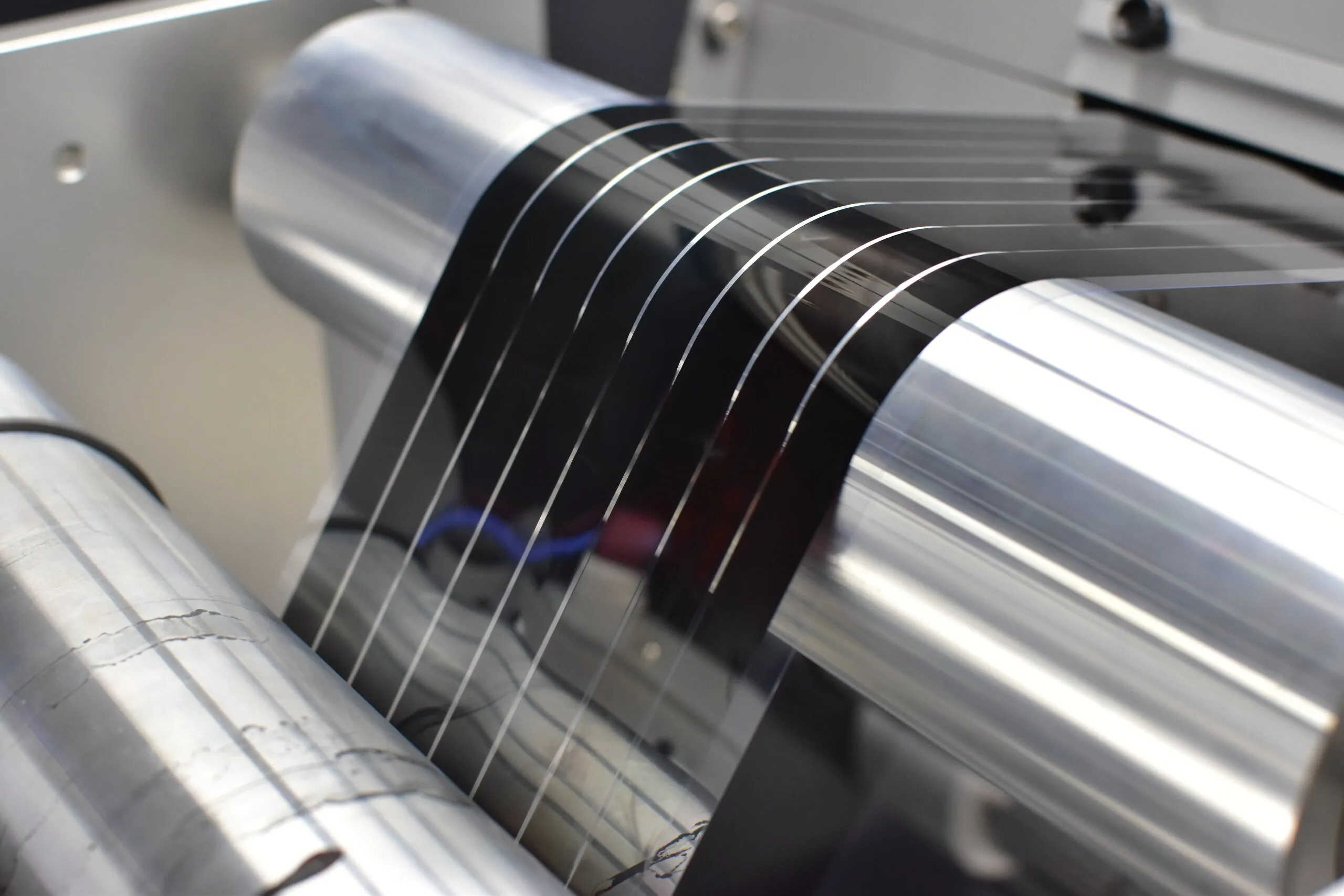
Courtesy of Active Surfaces
This award-winning startup with roots at the MIT Energy Initiative is developing lightweight, flexible, high-efficiency solar energy films designed to be used on roofs, walls, and any curved surface—including the roof of your electric vehicle.
Research areas
Active Surfaces, a startup based on solar-energy technologies rooted in MIT research, is well on its way to developing what co-founder Richard Swartwout SM ’18, PhD ’21 calls “solar 2.0.” The company’s technology is in response to a need Swartwout recognized while observing energy challenges in India during an MIT Energy Initiative (MITEI) fellowship.
Within the last two years, the company has raised more than $10 million in venture capital, corporate investment, and state grants, most recently announcing in October an investment from the Tokyo-based electric utility Electric Power Development Co., Ltd. (J-POWER). Active Surfaces also opened their current manufacturing development site—a 5,000-square-foot facility—in 2024 in Woburn, MA, that is now filled with industrial roll-to-roll printers and other equipment being cost optimized before the equipment is scaled up for a first-of-its-kind commercial-scale manufacturing plant.
Based on more than ten years of MIT research and resulting patents—three held by Swartwout—collaborators at Active Surfaces have developed a novel approach to solar. Instead of silicon, the “solar 1.0” technology that dominates today, their solar cells are made of perovskite, a class of materials that are cheap, abundant, lightweight, flexible, and highly efficient at absorbing and emitting light.
“We need to start thinking about more and more places to put solar,” Swartwout says, “and we need to dramatically cut the cost of manufacturing and installing it.” Active Surfaces is now designing the solar technology that can meet those goals.
In recent years, homeowners, electric utilities, and others have adopted silicon-based systems, and in 2024 installed solar capacity worldwide exceeded 2 terawatts. However, some experts believe that by 2050 the world will need 20 terawatts of installed solar capacity in order to meet rapidly increasing demand for electricity while also reducing carbon emissions.
A long-standing target
Silicon technology was fine for its original purpose—generating electricity for NASA’s early spacecraft—and later for utility setups in remote locations. No matter that the silicon solar cells are brittle and require heavy racks to support them. Swartwout first became aware of the limitations of silicon solar during a trip he took to India to observe energy challenges encountered by people in remote areas in 2016 as part of his fellowship from MITEI’s Tata Center for Technology and Design. In talking with residents, Swartwout heard repeatedly that people didn’t trust solar sources of electricity because the brittle panels “fail very prematurely in those sorts of locations.”
Motivated by that early experience plus the need for rapid worldwide growth in solar generation, Swartwout and Shiv Bhakta MBA ’24, SM ’24 co-founded Active Surfaces in 2022. The pair provides an unusual blend of expertise: Bhakta, the CEO, offers strong strategic market experience, while Swartwout, the CTO, spent a decade at MIT working on solar R&D and printed electronics innovation.
Other research groups have worked with perovskites, but the most promising compositions and manufacturing techniques were toxic, and managing their toxicity made large-scale manufacturing impractical. The Active Surfaces process instead uses a novel perovskite ink consisting entirely of nontoxic components. Layers of electronic material are deposited onto a thin substrate, and an electrode is deposited onto the surface to make a module. The solar modules are then protected from the environment using an epoxy that dries within seconds under an ultraviolet lamp. The module, now as thin as 15 microns thick, can readily be attached to any surface.
The finished solar film generates as much electricity as an equivalent surface area of silicon cell, and the confirmed durability under realistic temperatures and humidity exceeds 10 years. The lightweight, mechanically robust solar film is easy to install—an advantage that brings the overall cost way down compared to the cost of silicon solar. For a conventional rooftop silicon system, as much as half of the total cost is often for installation. “That’s because those panels are not designed to be easily deployed through general construction,” says Swartwout. “A flexible solar panel is much more in line with how we do construction. To put it on your roof, you would just unroll it like you would unroll an asphalt shingle or a roofing membrane.”
In addition, the flexible films can be fabricated by a cost-effective mass-production method called roll-to-roll manufacturing in which material is continuously unrolled from one spool and rewound onto another. The machines operate at high speed, and the capital investment required is low. As a result, says Swartwout, “there isn’t much benefit to having centralized manufacturing, so you can think about a distributed manufacturing model.” That solves another problem with the current silicon solar technology: China now manufactures almost all solar cells, and, notes Swartwout, “many countries don’t want to have their energy supply chains totally dependent on China. With our technology, you can have regionalized manufacturing locally…more like today’s auto market.”
Growing up but not cutting ties
While Active Surfaces’ films are not yet full-sized, they have been growing rapidly, Swartout says. “Within three months, our product went from lab-scale to six inches by six inches, and then within another four months or so, it went from that size to six inches by two feet—the biggest size that our current machines can process.” But, he adds, the six-by-six sample is “representative of what a minimum viable manufacturing process would be.”
The company continues to maintain its close ties to MIT. Several MIT professors are among the startup’s advisors. And the company is located just 15 miles from MIT, so staff members are frequently at MIT.nano, especially to make use of inspection tools like scanning electron microscopes and occasionally to use fabrication facilities not available at their own lab. In addition, the startup sometimes sponsors work at MIT.nano, in particular when they need a next-generation extension on one of the MIT patents. Swartwout calls the startup–MIT relationship a “good synergy” and comments that they set up Active Surfaces “with that in mind.”
Swartwout is optimistic about what’s ahead for Active Surfaces. “We think that we have a really huge market. So the upfront capital that our investors are committing is worth the end-stage growth of what [our technology] could actually do for the future energy landscape as a whole.”

