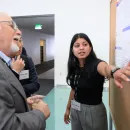
MIT Graduate Student Shreya Agarwal presents Future Energy Systems Center research on carbon dioxide capture and conversion at the 2025 Energizing@MIT: MITEI’s Annual Research Conference. Photo: Gretchen Ertl
Three of MITEI’s FY26 priorities are directly related to our research efforts—encouraging MITEI sponsors to fund more research, addressing the data center energy problem, and improving assessments for new energy technologies. MITEI’s research portfolio reflects our primary objectives of advancing the energy transition through low-carbon solutions, increasing energy security, and improving access to reliable, clean, and affordable energy.
MITEI connects researchers from across MIT and facilitates collaborations with industry, nonprofits, and government to speed the development of zero- and low-carbon technologies, with the goal of building sustainable global energy systems that can contribute to mitigating greenhouse gas emissions. At any given time, MITEI and its members support more than 100 active research projects, including innovative early-stage energy projects awarded through the MITEI Seed Innovation Fund Program. MITEI manages tens of millions of dollars for sponsored research annually, often building multidisciplinary MIT research teams to address fundamental or applied energy transition challenges. Through our Future Energy Systems Center, we use advanced system modeling and analysis techniques to assess the feasibility of decarbonization technologies and pathways. With our close collaborator, the MIT Center for Energy and Environmental Policy Research (CEEPR), we support research on energy and environmental policy and economics to support improved decision-making by government and industry.
With support from both member and philanthropic funding, MITEI launched 54 research projects in FY26 totaling over $28 million, a 20% increase in research funding from FY25. The focus area that garnered the most new research support this year was sustainable fuels, with funding of $7.84 million. The balance of this year’s research funding was allocated to support a range of other energy topics, including decarbonizing industry, management of the electrical grid, energy storage, and buildings. With support from its members, as well as numerous foundations, donors, various state and federal government entities, and university partners, MITEI has supported 1,117 projects from its inception through FY26.

Macro, a new computer modeling tool developed by a MITEI research team, will help infrastructure planners working in the electricity and other energy-intensive sectors better predict and prepare for future needs and conditions as they develop plans for power generation capacity, transmission lines, and other necessary infrastructure.
Funding for early-stage research
In FY26, six early-stage research projects submitted during the annual MITEI Seed Innovation Fund call were funded for a total of more than $1 million. Each of the six projects received $175,000 to explore novel energy-related ideas and open up new avenues of research that will help speed the clean energy transition. The chosen projects address challenges related to data centers, fast-charging batteries, and geothermal systems, among others. The projects were selected from 51 proposals submitted by 63 faculty and researchers across 21 departments, labs, centers, and initiatives.
Future Energy Systems Center
MITEI’s Future Energy Systems Center is a member-funded research consortium in which nearly all of MITEI’s member companies participate. The Center’s research portfolio aims to foster and inform interdisciplinary energy research across MIT, conducting integrative analysis of the entire energy system to understand the cross-sectoral impact of the energy transition. Using techno-economic and lifecycle analysis to examine energy pathways in different sectors, the Center enables its corporate members to explore and develop strategic energy plans, taking into consideration technology, economics, and policy.
- Future Energy Systems Center projects: The Center funded 16 new projects, bringing the number of active Center projects to 69. The topics of this year’s projects ranged from the market pathways and cost targets for long-duration energy storage in the United States to the quantification of nuclear energy and other firm low-carbon energy costs. MITEI will kick off meetings for the eight projects chosen at the end of FY26 at the Center’s September 2026 Workshop.
- Future Energy Systems Center meetings and workshops: In May, the Future Energy Systems Center held its spring workshop to kick off projects selected in late 2025 and to identify energy topics becoming new priorities for members. The Center workshop included sessions on energy storage, the path from innovation to grid deployment, electricity prices and household affordability, and regional energy transition challenges and opportunities in Europe. The Center workshop also included an advisory committee meeting and student presentations and a poster session. The Center workshop was coordinated with the CEEPR workshop, with half a day of overlapping sessions.
- Future Energy Systems Center webinars: The Center hosted 20 webinars to update existing projects, as well as four lightning talk sessions to allow members to review new proposals. The webinar series is a platform for MIT researchers from across departments to share insights on emerging technologies, policy developments, and sustainability challenges by highlighting the latest updates from their Center-supported projects.
- Technology dashboards: The Center developed technology dashboards to explore the energy transition through the lens of critical technologies. The dashboards provide members with assessments and pathway comparisons across cost, emissions, and energy efficiency. The dashboards are available to MITEI companies on the member website and so far include topics such as hydrogen, steel, fission, fusion, and enhanced geothermal.
- New focus area: The Center created the long-duration energy storage (LDES) focus area to centralize existing LDES work and bring together MIT researchers who will conduct analyses across key LDES use cases, assess leading technologies, and compare their costs, technical feasibility, and scalability. This work will help identify the most promising LDES pathways, key research gaps, and potential next steps for future member engagement, sponsored research, or broader studies on this topic.
There are currently 30 Future Energy Systems Center corporate members. The member companies span four continents and are involved in many sectors, including energy, utilities, automotive, semiconductors, mining/metals, chemicals, telecommunications, infrastructure, insurance, and engineering/construction. MITEI is in discussions with a number of prospective members.
Studies and reports
In FY26, MITEI launched the next in its series of “Future of…” studies with a two-year effort to examine sustainable fuel options for tough-to-decarbonize transportation, such as aviation, international shipping, long-haul trucking, and freight rail. The “Future of Fuels: Pathways to Sustainable Transportation” study is analyzing the production of sustainable fuels, including biofuels derived from biomass and e-fuels derived from hydrogen and captured carbon dioxide (CO2). The study will include a comparison between sustainable drop-in fuels and the major non-drop-in fuels, such as renewable methanol, ethanol, ammonia, and natural gas. A key aspect of the study is an analysis of policies for decarbonization long-distance transportation and of policies that could enable a more efficient trajectory for the switch to sustainable fuels. William H. Green, MITEI director and Hoyt C. Hottel Professor of Chemical Engineering, is leading the study, and Randall Field, MITEI’s director of research, serves as executive director.
MIT researcher highlights
Read a selection of articles from MITEI and MIT News featuring MITEI-supported research at MIT.

Publications
A selection of MITEI-supported journal articles published in FY26.
Federico Parolin, et al. Energy Conversion and Management. June 2026.
Multi-sector capacity expansion models play a crucial role in energy planning by providing decision support for policy-making in technology development, but these models require high technological, spatial, and temporal resolution, which can lead to large-scale linear programming problems. This paper aims to improve computational efficiency by proposing new decomposition strategies targeting the sectoral and spatial domains. Results show a substantial performance improvement.
Stephen J. Lee and Cailinn Drouin. Energy and AI. May 2026.
This paper presents a novel framework for high-resolution forecasting of residential heating demand and non-heating electricity demand using probabilistic deep learning models. This paper focuses specifically on providing hourly building-level electricity and heating demand forecasts for the residential sector. By offering an open-source, scalable, high-resolution platform for demand estimation and forecasting, this research advances the tools available for policy makers and grid planners, contributing to the broader effort to decarbonize the U.S. building stock and meeting climate objectives.
Sujit Modi, et al. Carbon. April 2026.
This paper demonstrates a single-step, continuous aerosol approach for synthesizing carbon-silicon composites, particularly promising anode materials for high-capacity lithium-ion batteries. This approach significantly reduces synthesis time, utilizes lignin (a waste byproduct of the pulping industry) as a carbon precursor, and enables additive-free encapsulation of silicon nanoparticles in carbon.
Philippe Jean-Baptiste, et al. Journal of Membrane Science. April 2026.
Industrial separations using membranes have long been considered a potential supplement or alternative to traditional heat-intensive methods that involve phase transitions. This paper presents an early attempt to manufacture an emerging class of polymers into industrially relevant hollow fiber membrane geometries while providing useful insights into the unique challenges of spinning microporous polymers.
Christopher M. Douglas, et al. Energy Conversion and Management. January 2026.
This paper presents a cradle-to-gate techno-economic analysis and lifecycle assessment of synthetic methanol production leveraging low-carbon electrolytic hydrogen and renewable CO2 captured from biomass- or biogas-powered bioenergy with capture or direct air capture facilities. Using a detailed chemical process model and a comprehensive cash flow analysis, the researchers evaluate the mass and energy requirements for renewable methanol production plants using an integrated approach that couples scale effects, feedstock and energy prices, process emissions, and several other variables.
Taemin Heo, et al. Computers and Chemical Engineering. November 2025.
This paper introduces a modeling framework for optimizing integrated design and scheduling of grid-interactive facilities with heat and mass integration and multiple co-products. Using a novel decomposition algorithm utilizing multiple linear approximations, the framework enables efficient optimization over 8760 hours of annual operation while including a large number of nonlinear constraints, improving scalability and performance as compared to previous methods.
Ernie I.H. Lee, et al. emote Sensing Applications: Society and Environment. November 2025.
The height of salt marsh vegetation is a key biophysical trait used to assess ecological health, monitor marsh restoration, and evaluate coastal protection from wave attenuation. This study defined a morphology-based correction that improved the accuracy of digital surface model (DSM)-derived canopy height for Spartina alterniflora. Furthermore, this study provides a framework for selecting drone flight settings, processing parameters, and predicting canopy-height correction factors to improve DSM-based plant height measurements in dense canopies and heterogeneous vegetation surfaces.
Zoe De Simone. Energy Policy. November 2025.
To develop incentive structures that balance long-term building-related carbon emissions and equity, this paper provides a model that combines a physics-based urban building energy model with U.S. homeowners’ willingness-to-pay predictions and a spectrum of incentive policies. The findings reveal that the researchers’ evidence-based policy framework facilitates the achievement of concurrent carbon reduction and equity goals, allows comparison of policies on the bases of long-term community impact, and avoids potential policy pitfalls of over and under incentivization.
Akshay Deshmukh. Chemical Engineering Journal. November 2025.
Membranes play an important role in the design of efficient industrial separations, which collectively account for 10-15% of global energy consumption. This paper develops a tractable, physics-based model that enables the rapid quantification of monomer and solvent impact on interfacial synthesis, which is essential for the rational development of new high-performance thin-film composite membranes.
Lohyun Kim, et al. Advanced Functional Materials. October 2025.
This paper develops a nanostructured palladium (Pd) “plug” composite membrane to mitigate key degradation mechanisms in conventional Pd membranes. The proposed Pd plug comprises discretized, thermally stable plug structures embedded in nanopores of a silicon‐based membrane. This paper establishes the Pd plug membrane as a strong candidate for high‐temperature H2 separations and illustrates the design of membranes with thermally stable metal nanostructures as a general strategy to realize high‐temperature H2 separations.
Rahman Khorramfar, et al. European Journal of Operational Research. September 2025.
This paper considers the generation and transmission expansion problem of joint power-gas infrastructure and operations planning under the uncertainty of both demand and renewable supply. This paper proposes two distributionally robust optimization approaches, and tests the resulting models and solution strategy through a New England case study under different levels of end-use electrification and decarbonization targets.
Jong-Soo Bae, et al. Materials Science and Engineering: A. September 2025.
This paper explores the influence of TiB2 on the additive manufacturing of Inconel 939 superalloy (In939) by laser powder bed fusion, showing exceptionally high-temperature strength and superior performance in In939+TiB2. This study paves the way for performance enhancement of critical components made of In939—like turbine blades and engine parts—in many sectors, including energy, aerospace, and automotive.
Daniela Ferreira-Garcia, et al. Current Opinion in Chemical Engineering. September 2025.
This paper proposes a transition from a linear to a circular economic model for agricultural production centered on converting waste streams into valuable resources. This approach will enable a paradigm shift from centralized production facilities to a distributed manufacturing model integrated with renewable energy infrastructure, supporting UN Sustainable Development Goals around food security.
Nancy Soliman, et al. Construction and Building Materials. August 2025.
This paper uses a top-down multiscale approach to investigate trade-offs in nano-carbon black (nCB) dispersion for optimal performance and sustainability of electron-conductive concrete. This research provides insights into nCB dispersion, aiding the design of advanced smart concrete with balanced conductivity and mechanical properties.
Yunsie Chung and William H. Green. Chemical Engineering Journal. July 2025.
This paper proposes a new modified Arrhenius equation that can correctly describe the temperature trends of liquid phase rate constants from room temperature up to the critical temperature of a solvent. By addressing the limitations of the original Arrhenius equation, this paper supports chemical reactions in subcritical or near-critical solvents, holding significant promise for numerous industrial and environmental applications.
Angelo Gurgel, et al. Journal of Cleaner Production. July 2025.
This paper explores decarbonization strategies in the iron and steel sector using the MIT Economic Projection and Policy Analysis (EPPA) model, a multi-sector, multi-region model of the world economy. Depending on technology assumptions, this paper finds that steelmaking can be more or less costly to decarbonize compared to the energy sector as a whole, with those associated costs strongly determining the scale of strategy deployment.