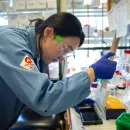
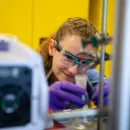
Katelyn Groenhout, an Energy Scholar in the 2025-2026 cohort, has been working in Yuriy Román’s (Chemical Engineering) catalysis lab using electrostatics to accelerate chemical reactions without using excess heat, which is the traditional method that requires large amounts of energy. Photo: Kelley Travers
Energy Studies Minor (ESM)
MITEI manages the ESM curriculum, which enables undergraduate MIT students to gain an integrative understanding of energy and develop the skills required of tomorrow’s energy professionals, leaders, and innovators in research, industry, policy, management, and governance. 224 students have graduated with the ESM, including eight who finished in June 2026. With the leadership from 2025 Chair of the Energy Minor Oversight Committee, Daniel Frey (Mechanical Engineering), and newly appointed Chair Matthew Evans (Physics), we streamlined the core curriculum requirements by removing non-essential economics prerequisites. We also incorporated seven new energy electives and awarded more than $112,000 in support of new energy courses. This investment increases the visibility and relevance of energy studies to students across departments, including computer science majors interested in the applications of AI/machine learning for analyzing and solving energy challenges. We also continue to coordinate closely with other energy, climate, and sustainability programs at MIT to enhance efficiency, engage more students, and build a wider network of students invested in energy and climate solutions.
Teaching assistant support
MITEI provided $150,000 in support for graduate teaching assistants in the following subjects: 11.192: Renewable Energy Siting Clinic (Spring and Fall terms), 22.081[J]: Sustainable Energy, EC.711: Introduction to Energy in Global Development, and EC.712[J]: Applications of Energy in Global Development.
Graduate Scholars
In 2025-2026, MITEI welcomed 20 new graduate students and postdocs to the Society of Energy Scholars (formerly known as the Society of Energy Fellows). The Energy Scholars network now totals more than 560 current and former graduate students and postdoctoral fellows, spanning 20 departments and divisions at MIT’s five schools and one college. This year’s fellowships were supported by MITEI member companies Shell, Chevron, ENI, Equinor, and ExxonMobil, and by Friends of MITEI.
Undergraduate energy research
During FY26, MITEI supported 98 Undergraduate Research Opportunity Program (UROP) student projects, bringing the total UROPs supported by MITEI since inception to 1,158. For the summer UROP cohort, MITEI sponsors optional weekly lunches, as well as periodic lunches with climate and sustainability UROPs. In addition, these students prepare a poster presentation for MITEI’s Annual Research Conference in September.
Online energy courses
To train global professionals, policy makers, and students in energy topics and tools to support and accelerate the energy transition, the MITEI education team has developed a series of open online courses (MOOCs) based on interdisciplinary residential MIT subjects. These courses are free and available in almost every country and have attracted more than 150,000 online learners since 2020. The courses include Sustainable Building Design; Sustainable Energy; Energy Economics and Policy; Transformative Living Labs in Mobility; and a newly offered course utilizing the SESAME modeling tool developed at MITEI, Systems Thinking in Energy: Navigating Costs, Emissions, and Impact.
IAP courses
MITEI provided $88,000 in support for nine IAP courses, workshops, and field trips in January 2026. These activities engaged approximately 200 MIT students and over 320 participants from the MIT community and beyond. Offerings included: Sustainable AI; Renewable Energy Facility Siting Clinic; Energy Policy and Planning in Practice; Energy Facilities Field Trips; Applications of Energy in Global Development: 4 Field Trips Abroad; Modeling Energy Systems for a Data-Center-Driven Future; Geothermal Energy Fundamentals: IAP bootcamp; and Intro to Thermal Energy Networks with Field Trips.
Discover the Energy Transition: First-Year Pre-Orientation Program
MITEI’s summer 2025 energy pre-orientation program welcomed 16 first-year students to the MIT community. Activities included a visit to a sustainable farm, tours of MIT’s Nuclear Reactor Lab and the Plasma Science and Fusion Center, a ride on a solar-powered boat on the Charles River, and talks with faculty and student group leaders.

During the 2025 Discover the Energy Transition: First-Year Pre-Orientation Program hosted by MITEI, students traveled on the Charles River on a solar powered boat from Worden Marine, led by founder and MIT alumni James Worden ’89. Photo: Charlotte Whittle
MIT Student Energy Groups
MITEI provides financial and staff support for a number of student groups throughout the year.
GEO@MIT is a student consulting group that equips students with cutting-edge research in thermal energy systems to accelerate the decarbonization of campuses and cities.
The MIT Energy and Climate Club connects students, alumni, and community members who are passionate about energy and climate change. Since 2004, MITEC has been a central platform for discussions about energy at MIT, the world’s leading technical institute.
The MIT Energy and Climate Hack brings opportunities for learning, problem solving, and networking to the forefront as teams develop rapid, innovative solutions to the problems in energy and climate that our society faces today.
MIT Motorsports is a student-run team that fully designs, manufactures, and races a new electric Formula One style race car every year. They compete in Formula SAE Electric, the largest intercollegiate engineering design competition in the world with over 600 participating universities, as well as Formula Hybrid + Electric.
The MIT Solar Electric Vehicle Team is a student group under the MIT Edgerton Center. Every two years they design and manufacture a solar-powered vehicle that competes in prestigious national and international competitions.
The MIT Sustainable Engine Team is a dedicated group of students at MIT passionate about the potential of hydrogen gas turbine engines. Through their designs, fabrication, and testing, they aim to elevate the efficiency of these engines.
MIT Wind focuses on the technical, logistical, ecological, and societal implications of adding renewable wind energy to the electricity generation mix. Undergraduates in MIT Wind compete in the Collegiate Wind Competition, an annual design competition hosted by the U.S. Department of Energy.