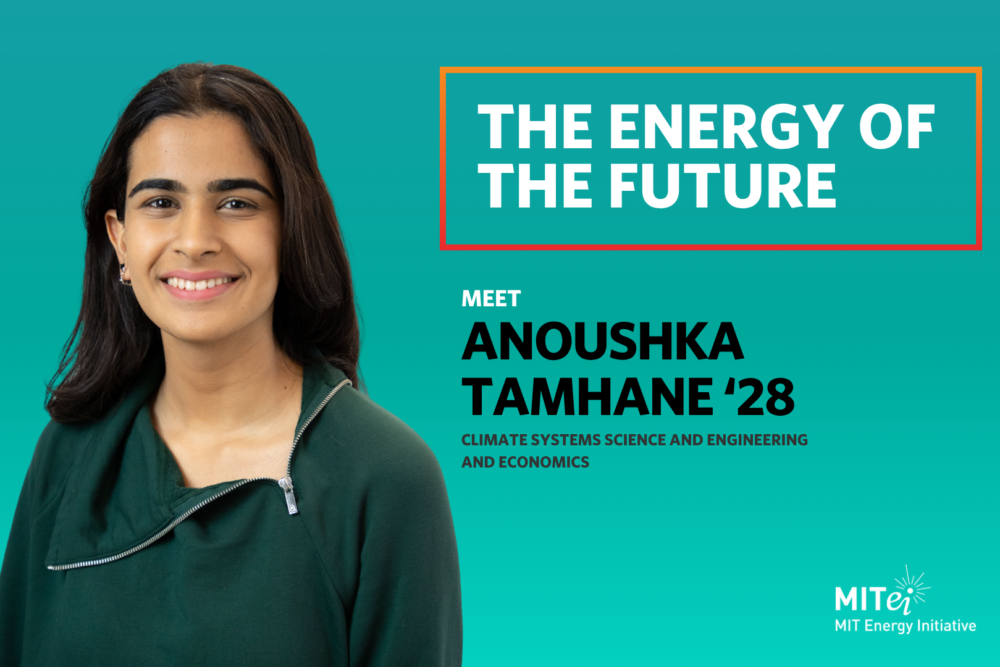
As a part of her MITEI Energy Undergraduate Research Opportunities Program (UROP) project, Anoushka Tamhane ’28 analyzed the causal effect of power outages on decision-making in solar and storage installations, facilitating the development of better policy incentives that are tailored to consumer behavior. Tamhane—a dual climate systems and engineering, and economics student—shares her drive to accelerate decarbonization efforts and how she applies this in her work leading MIT’s decarbonization club, Geo@MIT.
Q. What are you researching in your UROP?
A. When someone buys rooftop solar for their home, they may or may not choose to install a battery alongside it. My research seeks to understand why people choose to install storage and, specifically, if reliability is driving storage adoption. With climate change increasing the frequency and intensity of weather events, we’re seeing increased power outages. Solar energy alone won’t power your home during an outage—especially when a storm is involved—but solar energy coupled with battery storage can. My UROP focuses on the causal effect of power outages on solar and storage installations: if the power goes out more often, does that cause a house to install more storage? We’re analyzing the value of reliability brought on by storage, or the value that a household gains when your lights stay on during an outage.
Battery storage is a critical component of decarbonization. As I mentioned, renewable energy alone is not enough to meet our energy needs. Batteries bolster grid stability and performance, allowing for renewables to better integrate into the electrical grid. Especially with intermittent renewables—like wind and solar—storage allows for the energy generated during peak times to be deployed at a later time.
We’re currently at an inflection point where our grid system is aging, and it needs to be replaced. If we want to make sure that our grid infrastructure is robust, and ensure that we’re decarbonizing our grid, those are goals that should be in harmony. We need to build a grid storage system that can effectively and efficiently use renewables. My work looks at the diverse system of utilities, consumers, and policy to get a comprehensive perspective of our grid ecosystem. By understanding the consumer decision-making behind storage adoption, policy makers and utilities can understand how to get more people to adopt storage and to prepare the grid for that shift, respectively.
Q. What impact do you hope this research will have?
A. In addressing the climate crisis today, it’s no longer a question of lacking technical solutions. The challenges are far more political, economic, and sociological. If the technology exists, but we’re unable to get it implemented and into the hands of the people that need it most, then we’re not solving the problem. I’m approaching my research through the lens of energy economics, meaning I’m looking at the value of things and the factors shaping why people choose to buy them. Are there communities that want to adopt storage, but don’t have access to the capital needed? What communities are already buying storage? Which communities are the most vulnerable to climate change? Where is storage the most valuable to communities? How do demographic and geographic factors impact the value of reliability?
Ultimately, I hope this research will equip policy makers with the information needed to effectively incentivize storage based on consumer behavior, which is key to renewable energy adoption and the acceleration of the energy transition. A component of incentivizing storage is also determining the size of the incentive, depending on demographics, geography, and other factors: if the value of reliability is X and the customer has access to Y amount of capital, storage should be incentivized by the difference between X and Y. Even with a significant amount of uncertainty, we can still determine how large the subsidy should be to be useful, so policy makers know where their dollar can make the most difference.
Q. What is Geo@MIT and how does it contribute to decarbonization efforts on campus?
A. I currently lead Geo@MIT, which is a student club dedicated to decarbonization, on campus and beyond. We’re focused on the source of emissions from our buildings, primarily the two major sources: embodied carbon and building operations. Embodied carbon is the carbon in our concrete and cement; building operations are primarily emissions from heating and cooling, which make up around 24% of global emissions. In Massachusetts, and at MIT, we’re focused on geothermal energy. The earth beneath our feet is around 50°F, which is, on average, warmer than our winter temperatures and cooler than our summer temperatures. With geothermal, thermal energy can be transferred through underground fluid loops to allow for simultaneous heating and cooling in different areas. Our project for MIT’s campus analyzes the thermal needs on campus, what opportunities exist in Cambridge, and, specifically, energy extraction from Cambridge’s piped water system.
Another pillar of Geo’s work is addressing a common thread in the climate movement: informational barriers. We have project groups working on feasibility studies and informational materials. As I mentioned previously, there is proven technology, but it gets stuck in the implementation phase. Geo does continuous and purposeful community engagement, ensuring that we’re designing systems intentionally for communities. We also help students find careers in the climate space. There’s a shortfall of 7 million workers in the “green workforce,” yet 1 in 3 student workers can’t name a career they’d consider a “climate career”—much less one that’s income generating. Geo works to educate students on these careers and connect them to the energy industry.
I feel lucky to have access to so many resources here at MIT, including incredible professors and peers. I am driven to work on climate change and solving the climate crisis in part because of the opportunities this place has provided me. If I don’t do something with all that I’ve been afforded to help the planet, to help people as much as I can, then what am I here for?
MITEI’s Energy of the Future series highlights in video and text MIT students working to advance the energy transition and expand energy access.