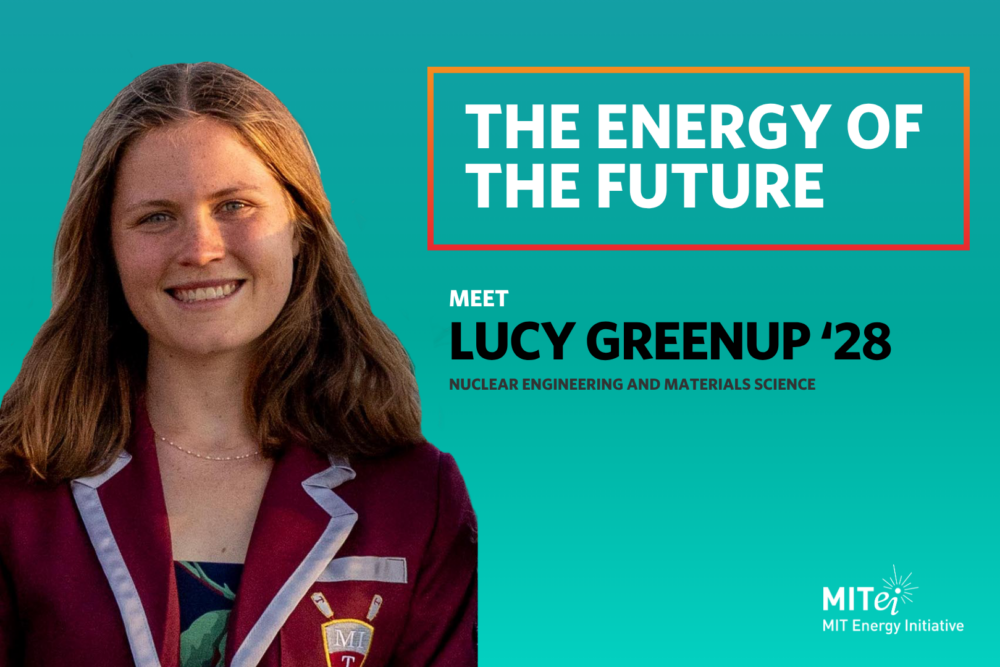
As part of her MITEI Undergraduate Research Opportunities Program (UROP) project, Lucy Greenup ’28 studied radiation defects in nuclear materials and how these materials can be returned from failure to function. Greenup, a nuclear engineering and materials science student, shares her excitement for the future of fusion energy and how her work in the MITEI Energy UROP is contributing to that future.
Q. What are you researching in your UROP?
A. My research focuses on gamma defects in vitreous silica, which is an ultrapure glass used in fiber optic cables. Fiber optic cables are used in superconducting magnets within fusion reactors as quench detectors. Quenches occur when part of a magnet loses superconductivity, which can cause a reactor shutdown. I study how gamma radiation interacts with vitreous silica, and how that response evolves as the fibers are warmed up from 77 Kelvin to room temperature. This is important because if optical fibers are going to be used in a fusion device, we need to understand their failure modes and how to resolve them.
We know that it’s possible to remove many defects through annealing, which involves heating the material up to room temperature. It’s been proven that this annealing restores vitreous silica to essentially pristine fiber function, but this is cost and logistically prohibitive since it would involve entirely shutting down the fusion device often. This can also cause thermal stress in reactor components and the downtime needed would pose a serious issue to the economic viability of fusion.
My research aims to find intermediate temperature values that can be used to get the most return and annealing—without going all the way up to room temperature. I do this using transient gradient spectroscopy (TGS) which is a spectroscopy technique that uses lasers to track the evolution of thermal diffusivity and surface acoustic wave speed. We use these as proxies for defect population in vitreous silica.
Q. How does this work contribute to the advancement of fusion energy?
A. In fusion reactors, it is essential that the superconducting magnets retain their superconductivity. To do this, they must stay below the critical surface, which is a function of magnetic field, critical current density, and temperature. As I mentioned, fiber optic cables are put in superconducting magnets to detect quench events. A quench event happens when any part of a fusion magnet loses its superconductivity. Usually, this manifests as one spot in the magnet heating up, which can propagate further and push the entire magnet above the critical surface. One of the ultimate failure modes of a fusion device would be a catastrophic quench event. Preventing a fusion reactor from suddenly shutting down is incredibly important and this requires many systems working in tandem, including a quench detection system that’s capable of indicating an event before it becomes entirely destructive. This research is a key component of making reliable fusion energy a reality.
Q. Why did you decide to pursue nuclear engineering?
A. It’s an incredibly exciting field to be in. Most people don’t just end up in this major, so people are usually really passionate about their work. One of the luckiest parts about going to a school like MIT, where undergraduate research opportunities are so common and readily available, is that you can really contribute to solving these big problems and make a difference early on.
More personally, there are three things that drew me to nuclear engineering, particularly fusion. First, I just love learning about it. I’m primarily interested in nuclear materials. Studying how materials interact with radiation and how massive damage can occur from something you can’t even see with the human eye is fascinating to me.
Second, fusion energy promises a carbon-free, unlimited energy source, which sounds almost too good to be true. We desperately need a carbon-free energy source to prevent the worst effects of climate change. Whether we can achieve fusion on a necessary time scale to do so is still a question that needs to be answered, but we’re getting closer.
Third, from my perspective, most of the roadblocks to fusion are engineering questions—solvable engineering questions. We have to learn to build and run massive superconducting magnets that don’t quench, can survive thermal cycling, and withstand strain. There’s solid physics behind all of that, so it’s really the real-world engineering applications that are the questions at play. Many components need to be built and tested in an incredibly short timescale, but I believe these are achievable goals. Fusion is one of those fields where we’re all working towards one collective goal that everyone is really excited about—it feels like you’re on the precipice of something big.
MITEI’s Energy of the Future series highlights in video and text MIT students working to advance the energy transition and expand energy access.