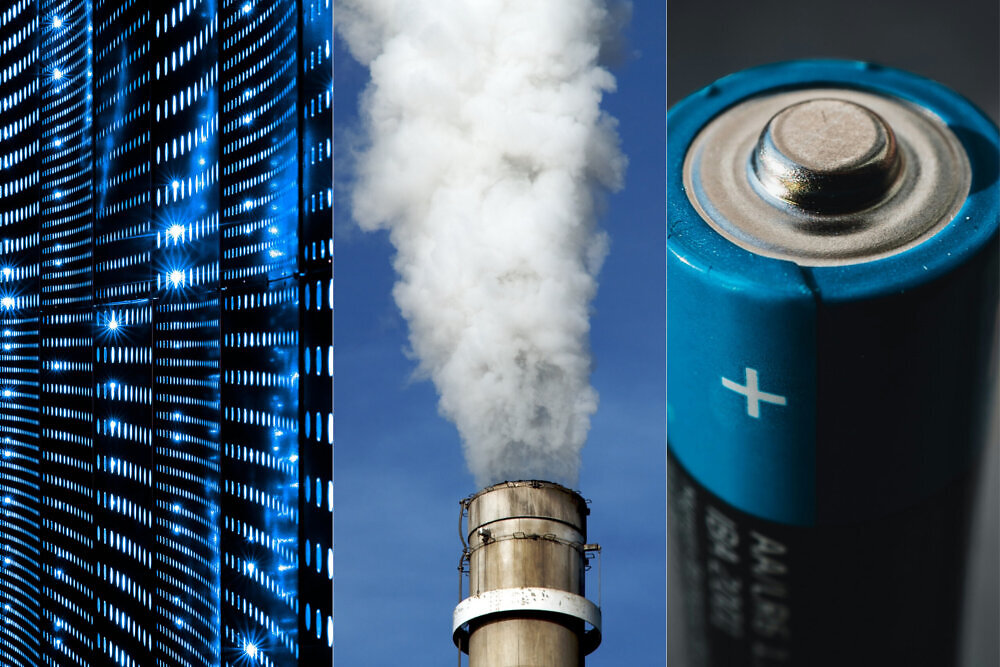
The MIT Energy Initiative (MITEI) recently awarded six grants totaling more than $1 million through its Seed Innovation Fund program, which sponsors early-stage MIT research projects aimed at supporting the energy transition. Each of the six funded projects will receive $175,000 to explore novel energy-related ideas and open up new avenues of research that will help speed the clean energy transition.
“The Seed Innovation Fund is a critical component of MITEI’s energy research effort. We are grateful to the participating companies and donors for sponsoring MIT researchers to test out high-risk ideas and develop new inventions that address gaps in energy technology,” says William H. Green, director of MITEI and the Hoyt C. Hottel Professor of Chemical Engineering.
This year’s chosen projects address challenges related to data centers, fast-charging batteries, and geothermal systems, among others. The projects were selected in a competitive process that takes place annually. This year, 51 proposals were submitted by 63 MIT faculty and researchers across 21 departments, labs, centers, and initiatives. Thirteen of the submitted proposals involved collaborations of two or three investigators.
To date, the MITEI Seed Innovation Fund Program has supported 240 energy-focused projects through grants totaling more than $32 million. This funding comes primarily from MITEI’s Founding and Sustaining Members, supplemented by philanthropic donations.
Brief descriptions of the six newly funded projects along with their principal investigators (PIs) follow.
Reducing energy use for cooling in data centers
About 40% of all the energy consumed by data centers is used to circulate liquid coolant through extensive networks of pipes and remove the heat generated by the densely-packed computer components. In this project, researchers will develop a systematic understanding of how to formulate self-assembling polymer coolants with microstructures that reduce the frictional drag and flow more easily through those liquid-cooling loops. The lower friction will result in significant energy savings in current and next-generation AI data centers.
PI: Gareth McKinley, School of Engineering Professor of Teaching Innovation in the Department of Mechanical Engineering
Speeding the conversion of captured carbon dioxide into useful products
To mitigate climate change, we can capture carbon dioxide (CO2) in emissions or remove it from the environment and then convert it into something useful, such as methane. While methane in the atmosphere is a potent greenhouse gas, it is also valuable as a clean-burning fuel and as a feedstock for making a range of commercial products. This project aims to develop a catalyst that will self-assemble to have a nanostructured surface ideal for speeding up the rate at which CO2 is converted into methane.
PIs: Caroline Ross and Alfredo Alexander-Katz, both professors in the Department of Materials Science and Engineering
A library of critical data to help in the design of fast-charging batteries
Much work is now devoted to developing batteries that will charge more quickly. But the research typically depends on costly, time-consuming trial-and-error methods of determining how quickly electrical charge is transferred through different cathode coatings. By using new physics-informed computational models, researchers in this project will assemble a library of material interfaces with tailored properties. These interfaces will guide the creation of novel coatings for fast-charging batteries—a critical but poorly understood component of the underlying technology.
PI: Troy Van Voorhis, Haslam and Dewey Professor of Chemistry in the Department of Chemistry
“Biomining” for microbes as novel candidates for recovering critical minerals from waste
Critical minerals are essential components of clean energy technologies, but the energy intensity and environmental damage associated with the recovery of those minerals often eliminate any benefits from the clean technologies into which they are incorporated. New technologies are needed across the mining industry to enhance resource recovery in a sustainable way. This project seeks to develop microbes found in extreme environments as novel materials for the “green mining” of critical minerals from waste.
PI: Ariel Furst, associate professor in the Department of Chemical Engineering
Electric field–driven catalysis for energy-efficient chemical manufacture
The chemicals-manufacturing industry relies on catalysts to speed up critical chemical conversions. But those catalysts typically require high temperatures to operate efficiently, and they deactivate over time so require periodic renewal. In this project, researchers will apply small electrical potentials—only a few hundred millivolts—to increase reaction rates by orders of magnitude under milder conditions, thus decreasing energy consumption and extending the lifetime of the catalyst. The research team will establish the scientific and engineering principles needed to translate this effect for industrially realistic reactors and to extend it across multiple reaction systems, thereby advancing the decarbonization of key energy-intensive sectors.
PI: Yuriy Roman, professor in the Department of Chemical Engineering
Developing a digital twin to support design and operation of enhanced geothermal systems
A digital twin is a replica of a real-world system or process that allows users to simulate the performance of the system or process. In this project, researchers will develop a digital twin of a geothermal system by combining physics-based modeling and machine learning. The resulting tool will—based on limited measurements—predict how a given geothermal reservoir will evolve and guide safer, more efficient operation. The goal is to help expand geothermal energy as a reliable, low-carbon power source.
PI: Sili Deng, associate professor in the Department of Mechanical Engineering