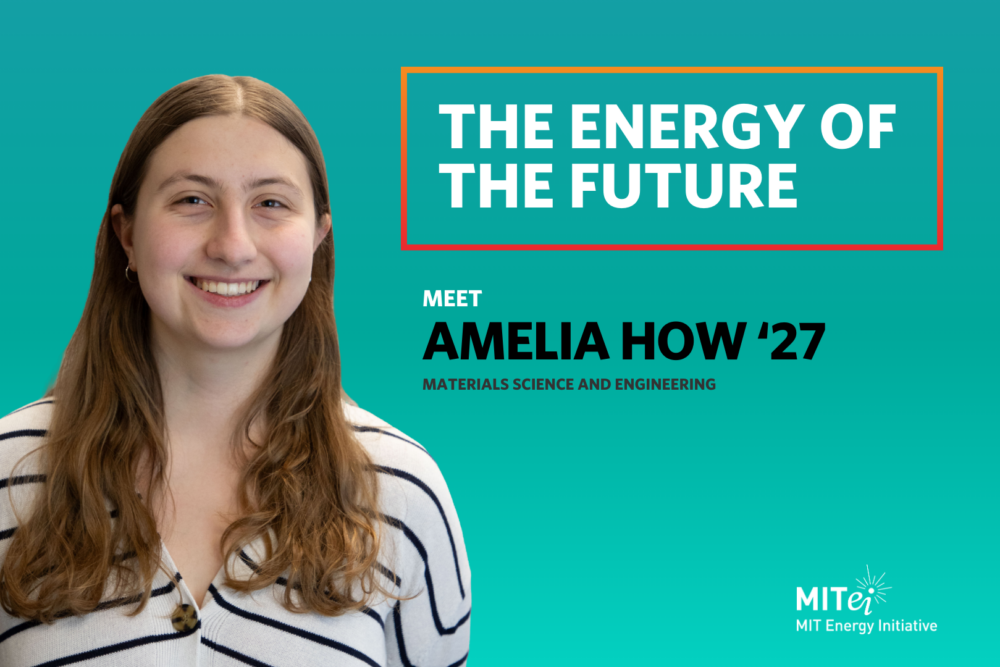
As part of her MITEI UROP, Amelia How ’27 develops methods to minimize hydride formation in titanium, which enables the reduction of structural deformation in energy infrastructure materials. How, a materials science and engineering student, shares her experience in the Energy Undergraduate Research Opportunities Program (UROP) and how she hopes to apply that knowledge going forward.
Q. What are you researching in your UROP and what impact do you hope your work will have?
A. I’ve been working with the Tasan Group, led by Associate Professor Cem Tasan, for two years now. During that time, my research has focused on hydride formation in hydride-forming materials. Though I’m currently working specifically with titanium, our findings can be applied to other metals, like magnesium and zirconium.
Hydride formation occurs when hydrogen enters a material and instead of remaining in its atomic hydrogen form, it forms a hydride—titanium hydride in my research. When this happens, the titanium loses ductility, leading to premature fracture. Other mechanical properties, like strength and hardness, can also be affected by hydride formation.
The primary goal of my research is finding methods to retain the mechanical properties of titanium, regardless of the environment it’s in. We have found that we’re able to localize hydride formation into just the surface of titanium, preventing it from permeating further. We do this by applying a surface treatment to the metal, which involves putting significant deformation on the surface. Through our work, we’ve developed an easy and widely available way to apply this treatment and maintain titanium’s mechanical properties. We hope to continue this work by applying it to other hydride-forming materials.
The premature fracturing and embrittlement caused by hydride formation pose a pretty significant challenge in a lot of different industries, since hydride-forming materials are everywhere. Titanium is used in a lot of structural applications, like airplanes, bridges, and pipelines. Zirconium is used in nuclear reactors, usually nuclear fission reactors. Unexpected failures and fractures in these scenarios would obviously be incredibly dangerous. So, this work very literally supports that infrastructure, including energy infrastructure like nuclear reactors and offshore wind turbines.
Q. When did you become interested in materials science?
A. My interest in materials science started towards the end of high school. I had always been interested in chemistry and physics. From there, I developed an interest in structural materials. During my senior year of high school, I interned at Commonwealth Fusion Systems, which is an MIT spin-off company. I worked on their materials team, focusing on metallurgy. I gained a lot of knowledge about materials—the different types of metals, how they’re selected and characterized, and how to analyze them. I also learned about the materials challenges in a fusion environment. That experience really cemented my interest in pursuing metallurgy.
Q. As an engineer, what drives you to solve problems?
A. I think that, at MIT, there’s this unique ability for undergraduates to access labs and get involved in research. Having research experience as an undergraduate is important because you get a concept of how that system works and how different every project can be. It’s shown me that I’d like to continue doing this kind of work, and it’s given me that additional context I’ll need in graduate school.
Being an engineer and working in a lab, you learn very quickly how to fail without it being a disaster. It’s a whole mindset shift from how you approach classes. When you fail a test, it feels like the end of the world, but when you work in a lab, not every experiment is going to go to plan—especially not the first time. It’s important to fail and see that something didn’t work, then ask yourself why that happened and how to do it better next time. Mistakes become a learning experience, and I think that’s something that’s really unique to research.
I joined the Tasan Group as a freshman at MIT, and I’ve stuck with it ever since. It’s been really rewarding to see this hydride project develop from start to finish, and to have this tangible result to the problem we set out to investigate. I was able to co-author the paper we just submitted, which is an experience that I never would have expected to happen in the short time I’ve worked in the metallurgy space. I’m really excited about that and I’m excited for my projects to come.
MITEI’s Energy of the Future series highlights in video and text MIT students working to advance the energy transition and expand energy access.