
On September 5, 2021, a full-scale, high-temperature superconducting electromagnet successfully produced a record-breaking field strength of 20 tesla, making it the strongest fusion magnet in the world. This demonstration by MIT’s Plasma Science and Fusion Center (PSFC) and MIT-spinout Commonwealth Fusion Systems (CFS) was a major milestone in the quest to build the first fusion power plant capable of producing more power than it consumes.
It took three years of intense research and design to get to that moment, with countless researchers and organizations helping behind the scenes. One such organization was the Italy-based energy tech company, Eni S.p.A.
It was during a 2016 meeting for the MIT Energy Initiative’s (MITEI) External Advisory Board that the company was first introduced to recent advances in magnet technologies and their potential to make carbon-free fusion energy practical. From there, MITEI and PSFC worked with Eni to make clear the impact of this technology and to explore pathways for Eni’s participation.
“Eni’s interest in fusion energy emerged from a combination of scientific insight and strategic foresight. Early discussions with MIT’s Plasma Science and Fusion Center revealed that the technological convergence of superconducting materials and high-field magnets could lead to more compact fusion reactors within decades,” said Lorenzo Fiorillo, the director of technology, R&D, and digital at Eni.
In March 2018, this interest had solidified into a commitment. Eni reached an agreement with MIT for a “first-of-its-kind” collaboration: Eni would fund fusion research projects run out of PSFC’s new Laboratory for Innovation in Fusion Technologies. At the same time, Eni announced it would become a strategic shareholder of the newly founded CFS as it worked to develop a commercial fusion power plant.
Eni’s interest and investment in fusion research and in CFS represents a major milestone in the 17-year relationship between Eni and MITEI. Over that period, Eni provided MITEI with insight into the real-world challenges the company faced as it worked to evolve from a traditional oil and gas company into an energy company with diversified interests in renewables, energy storage, sustainable fuels, and more. In turn, MITEI helped Eni connect with MIT faculty members and researchers interested in developing new technologies to address the changing energy landscape.
Through its engagement with MIT and CFS, Eni was an early player in the fusion space, which is now attracting billions of dollars from investors and governments around the world. Eni continues to collaborate with CFS “through its shareholding and strategic engagement on technology transfer, materials testing, and supply-chain,” says Fiorillo. CFS recently raised second-round funding of $863 million (Eni was an investor, as well as VCs, equity firms, and companies, all following Eni’s lead), bringing the company’s total funding to almost $3 billion. And in September, Eni and CFS signed a power purchase agreement for Eni’s acquisition of decarbonized power from CFS’s 400-MW ARC fusion power plant in Chesterfield County, Virginia, which is expected to connect to the grid in the early 2030s.
The beginning of a collaboration
Eni first engaged with MIT as it entered discussions to join the recently formed MIT Energy Initiative as a founding member—officially signing its membership agreement in 2008. “Becoming a MITEI member provided a unique opportunity to engage directly with cutting-edge research on decarbonization, new materials, digitalization, and energy systems, while cultivating talent and creating a long-term space for collaboration,” said Fiorillo.
While once recognized primarily as a traditional oil and gas company, Eni has evolved over the last decade to become an integrated global energy tech company “with a clear path to net zero by 2050,” says Fiorillo.
Working with MITEI has helped Eni explore a wide range of new energy technologies, according to Morgan Andreae, the executive director of the Eni-MIT Alliance. “The collaboration has informed Eni’s technology strategy as they determine the best pathways to participate in the energy industry in the future,” he says. In his capacity as executive director, Andreae works closely with Eni to build their research portfolio by identifying MIT research activities that align with their technology strategy and decarbonization goals.
“MITEI serves as both an innovation partner and a catalyst that connects Eni’s industrial expertise with global research excellence,” says Fiorillo. “What began as focused collaboration on specific research projects has evolved into a comprehensive and enduring strategic alliance.”
Supporting the energy transition
As a MITEI founding member, Eni has supported MIT energy research in numerous decarbonization technologies, including fusion, solar, energy storage, sustainable fuels, and carbon capture, utilization, and storage (CCUS). MIT and Eni’s joint research has also included cross-disciplinary fields such as digital simulation, AI-based optimization, and advanced process modeling.
Fiorillo called CCUS “one of the greatest areas of current collaboration between Eni and MITEI.” He noted that as CCUS becomes increasingly important as a lever to tackle emissions from hard-to-abate industrial sectors, studying technologies and processes that reduce carbon capture costs have become more urgent. “This demonstrates a direct link and valuable complementarity between Eni’s engineering and reservoir expertise, which enables it to tackle highly complex CCS and CCUS projects in Italy and around the world, and MIT’s scientific excellence, which finds fertile ground in MITEI,” he said.
Over the years of their membership, Eni has been one of MITEI’s largest energy research sponsors. Their engagement with MIT has resulted in more than 60 technology disclosures for innovations, 125 projects, and more than 230 scientific articles.
“This collaboration has had a big impact at MIT,” says Andreae. “Eni’s funding has been a critical enabler to energy technology research in many areas, and the funding has supported a large number of faculty, researchers, and students—enabling them to build skills and advance their careers.” As part of its membership, Eni supports the work of MIT PhD students and postdoctoral researchers through MITEI’s Society of Energy Scholars.
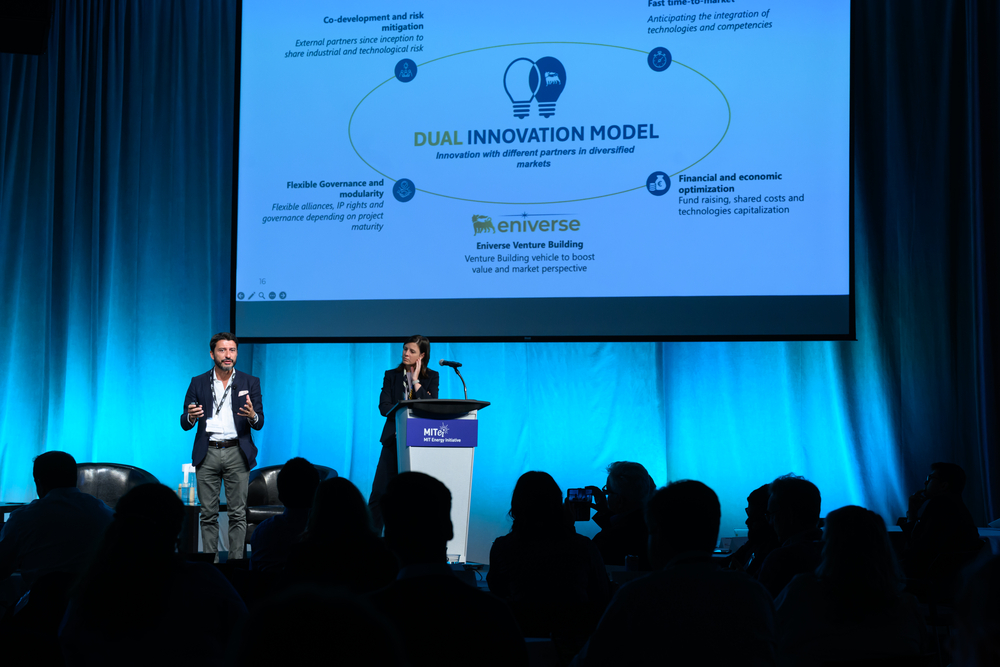
Giacomo Silvestri (left) and Annalise Muccioli (right), both of Eni S.p.A., presented the opening keynote address on Eni’s strategic response to emerging energy challenges at Energizing@MIT: MITEI’s 2025 Annual Research Conference.
Looking forward
MITEI and Eni continue to explore how to better ensure research has a real-world impact. For technology development projects that are closer to commercialization, MITEI and Eni are piloting a new approach to intellectual property (IP) management called “translational research projects.” “This approach gives the sponsor, Eni, more flexibility in managing any IP that is developed within the project, and will provide more options for commercialization,” says Andreae.
“The relationship with MITEI has been nothing short of transformative,” says Fiorillo. “It has opened direct access to frontier research and, even more important, has fostered a collaborative culture that integrates academic creativity with industrial pragmatism. This model has accelerated the pace of innovation within Eni, particularly in the development of technologies that move quickly from concept to prototype.”
At Energizing@MIT: MITEI’s Annual Research Conference this past fall, representatives from Eni shared the company’s current technology strategy and how MITEI’s expertise and collaboration contributes to their “integrated vision of sustainability.” Fiorillo referred to MITEI as both an “innovation partner and catalyst that connects Eni’s industrial expertise with global research excellence.”
As MITEI continues to advance research aimed at decarbonizing global energy systems, MIT faculty and researchers benefit from industry insights and knowledge of the biggest problems energy companies are facing today. “Engaging with an industry leader like Eni ensures that we focus on the important energy challenges,” says William H. Green, the director of the MIT Energy Initiative. “Eni has a greater understanding of the energy landscape and the challenges industries face than we do as an academic institution. With Eni’s insights, MIT researchers are able to focus on the really important questions that will accelerate the adoption of decarbonization technologies and further translate research into real-world impact.”