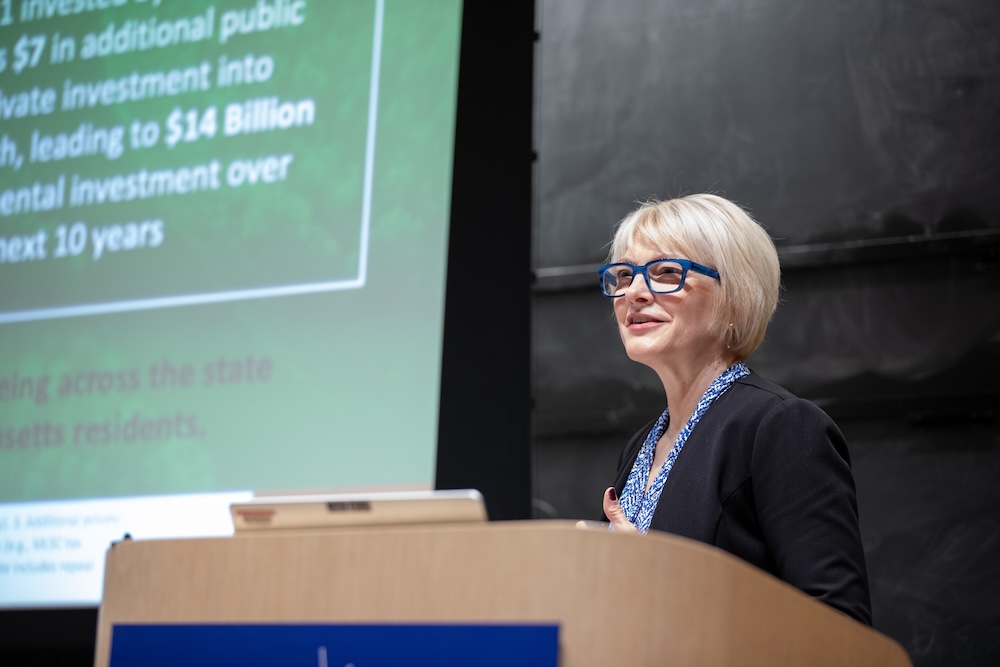
Massachusetts is uniquely positioned to become a leader in climatetech, said Emily Reichert, the CEO of the Massachusetts Clean Energy Center (MassCEC) and former CEO of Greentown Labs, to members of the MIT community at a seminar in November. Reichert outlined the interconnectedness of economic development and clean energy innovation in MassCEC’s efforts to advance the energy transition and address climate change, as part of the MITEI Presents: Advancing the Energy Transition speaker series. An MIT Sloan alumna, Reichert stepped aside as the agency’s CEO in late November and the MITEI speaker series was her final presentation in that role.
“There’s not another [agency] in the country exactly like us focused on innovation and economic development for clean energy and climatetech,” stated Reichert. Created in 2008, MassCEC is the state’s economic development agency dedicated to the growth of the clean energy and climatetech sector. Reichert stressed that economic development is just as much about businesses as it is about the jobs they create.
The organization’s economic development plan is built on its knowledge of the Commonwealth’s infrastructure, talent capabilities, academic resources, startup culture, and regional strengths. Reichert shared that there are four areas at the core of MassCEC’s work.
First, bringing emerging climatetech ideas out of the laboratory and into the world. To do this, MassCEC provides grants, internships, and has a small investment fund that is co-invested with different investors in the area. “We are increasingly focusing on the longer-term growth trajectory of these young companies,” said Reichert, adding that the hope is for these startups to stay, grow, and create jobs in Massachusetts.
Second, MassCEC aims to accelerate decarbonization by taking commercialized technologies and helping to get them into as many homes and businesses as possible. This can often require specialized knowledge of Massachusetts’ infrastructure, given that the state has relatively older buildings and unique structures such as triple-deckers. For example, finding a way to make charging technology available to electric vehicle owners when they don’t have a single-family home with a garage.
MassCEC is also focused on enabling the large-scale deployment of offshore wind. “It’ll be 400,000 homes that are powered by the clean energy that’s being generated by offshore wind right off the coast of Martha’s Vineyard. MassCEC’s role is to support the port infrastructure from which we marshal those offshore wind projects,” stated Reichert. “We also support innovation that is needed to do all the things that support the offshore wind industry, in general.”
Finally, Reichert reiterated that MassCEC’s overarching goal is to support clean energy workforce development through job creation as well as professional development opportunities, such as providing internships, training for high school and community college students, and supporting students returning to school for a second career in clean energy.
Reichert emphasized that Massachusetts is particularly well-equipped to house this level of climatetech innovation since the state is already a leader in the life sciences. The Healey-Driscoll administration charged MassCEC with spearheading the state’s Climatetech Economic Development Strategy and Implementation Plan, a 10-year strategy to position Massachusetts as a global climatetech leader and drive a more equitable and resilient climate future.
To complement this plan and further position the state as an epicenter for energy innovation, the Healey-Driscoll administration also passed the Mass Leads Act, which established the Climatetech Tax Incentive Program, an annual tax incentive to be administered by MassCEC. “This is the money piece,” said Reichert. “How we do it. How we implement it.”
To unlock Massachusetts’ full potential, MassCEC uses a regional approach to take advantage of the strengths held in each area of the state. “We have a fantastic ecosystem. We have more startups per capita than any other state,” said Reichert. The quantity of startups is in large part due to the strengths of the Greater Boston region, with its strong venture capital community and good research institutions, said Reichert, who also highlighted MIT as a key factor. MIT spinout companies like Sublime Systems, Commonwealth Fusion Systems, Boston Metal, and The Engine are all part of MassCEC’s ecosystem.
For the agency, retaining talent in Massachusetts is just as important as supporting its development. “How can we help companies to do their processes, find their facilities, build their facilities, do their demonstrations, do their testing, and find the talent?” asked Reichert. “How can we reduce the time and money barriers to all of that, and therefore make it as easy as possible and as inexpensive as possible for the company to stay here and grow here?”
Reichert expressed her confidence in climatetech innovation’s ability to endure the changing energy landscape. “The rest of the world is going in this direction. We can decide not to compete as a country, or we can decide that we want to compete and that we want to be part of the future,” said Reichert. “Innovation isn’t going anywhere. I think when you have places like MIT, who are very focused on climate innovation and the energy transition, that activity helps move the ball forward.”
MITEI Presents: Advancing the Energy Transition is an MIT Energy Initiative speaker series highlighting energy experts and leaders at the forefront of the scientific, technological, and policy solutions needed to transform our energy systems. The series will continue in Spring 2026. For more information on this and additional events, visit: energy.mit.edu/events/