Roger Martella, CCO of GE Vernova, emphasized the need to couple electrification investments and prosperity for both the planet and people.
The era of action for the energy transition
Kelley Travers
At MITEI’s Fall Colloquium, GE Vernova’s Roger Martella shares his optimism when looking to the future of energy innovation and investments and highlights MIT’s role in that transition.
Research areas
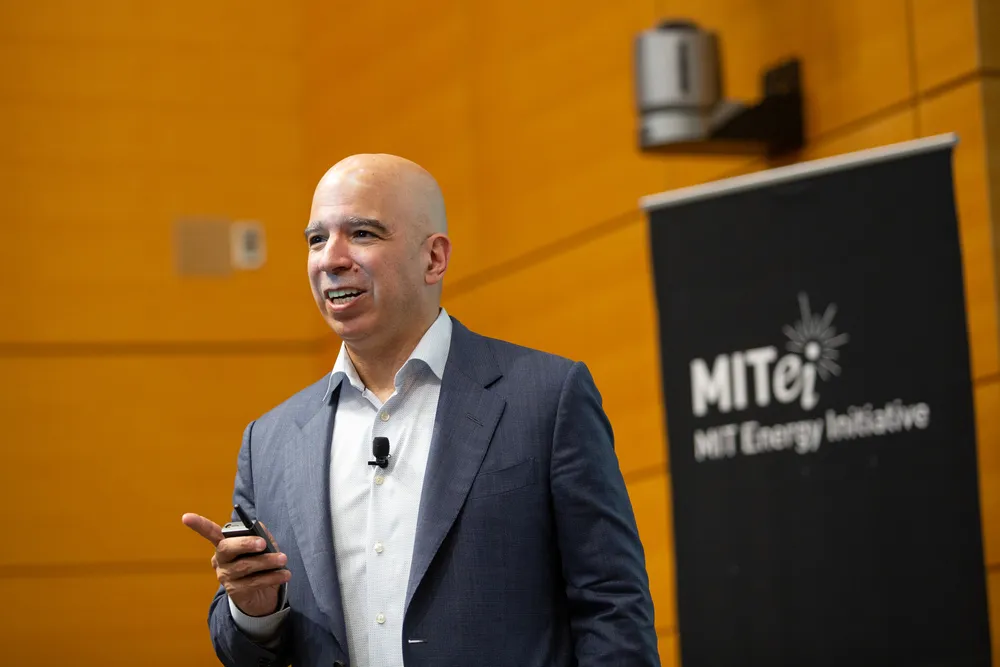
The significant momentum behind energy and climate investments is cause for excitement and optimism for the future of electrification and decarbonization, said GE Vernova’s Chief Corporate Officer Roger Martella at MIT earlier this month.
“We are seeing action, we're seeing investments, we're seeing progress in ways that I think are going to meaningfully change and solve these issues for the future,” said Martella, who is also head of global government affairs and policy and chief sustainability officer at GE Vernova. Martella spoke November 5 at the MIT Energy Initiative’s (MITEI) Fall Colloquium.
GE Vernova is an energy equipment manufacturing company that, in April 2024, spun off from General Electric as an independent, publicly-traded company, allowing the company to fully dedicate itself to electrifying the planet and uplifting its people. “Electricity is the lifeblood of prosperity, but also of achieving goals for decarbonization and climate change,” said Martella.
Now, as an independent company, GE Vernova can broaden its impact, supporting breakthrough decarbonization technologies across sectors. “We helped produce 25% of the world's electricity through our gas turbines, wind turbines, nuclear energy, and electrification equipment, which is becoming increasingly important,” said Martella. “90% of global power transmission utilities are equipped with our electrification equipment, and about 50% of electricity in the United States moves through our equipment.”
When it was time to find a location for GE Vernova’s headquarters, Martella explained that the decision to settle in Kendall Square was a very intentional choice—it allowed the company to immerse itself in the MIT community’s spirit of innovation and engage with students excited about working in energy. Around 15% of MIT engineering undergraduate students applied for internships at GE Vernova last year, according to Martella. The company recently announced that it plans to double MIT intern and permanent hire numbers in 2027.
“We want to inspire that workforce of the future. We want future leaders to know that they can spend the next decades of their career invested in this space and really having impact on solving some of the world's biggest challenges, having that sense of purpose, that sense of mission,” said Martella.
GE Vernova’s research collaboration with MIT is focused on the intersection of electricity and climate change, with four pillars: renewable energy, electrification, decarbonization, and digital transformation, Martella explained.
“It's like inventing the future. Your academics, your researchers, your professors, your students, your fellows—you're all inventing the future. Every time I come here again, I walk away saying ‘I just walked through a time machine,’ because I see how far ahead people are thinking,” Martella said about MIT’s ability to turn concepts into reality.
GE Vernova values transparency in its work, Martella emphasized. The company plans to highlight real-time impacts through a tracker on their website. The dashboard shows how much capacity is being put on the grid, how far the company has progressed on various goals, how emissions have been impacted, and more.
In this work, Martella reminded the audience that GE Vernova’s mission is two-fold: electrification for the planet and for people. In service of that, their website also tracks the approximate number of people impacted by their electrification efforts. “There's hundreds of millions of people—probably more than a billion people—that lack access to affordable, reliable, sustainable electricity,” he said. “We have set a goal that we will very intentionally, in any given year, aim that 30% of electricity we put on the grid will be in underserved communities.”
This aspect of GE Vernova’s mission is also incorporated into its relationship with MIT and company leadership’s hopes to build their workforce from MIT’s students. GE Vernova is also hoping to make a positive impact when building their workforce: “We have to look to communities that have been underserved in access to STEM careers,” said Martella, who added that these factors also play a role in hiring.
“What's going to happen in this next generation of leaders, it won't just be for your degrees, master's degrees, or PhDs. It's going to be a lot of vocations, trades, and people who actually install and operate this equipment on the ground. There's room for everybody.”
Looking to the future, Martella anticipates that the trend of energy and climate leadership being passed from the public to the private sector will continue. Historically, the government has taken a lead in energy and climate policy, but that has changed in recent years, according to Martella. “If we're going to succeed on these topics, the private sector has to lead. The government is not going to be able to invest at scale. They're not going to be able to implement at scale the way the private sector can,” said Martella.
“You have to focus on the long-term view,” said Martella. “There will be some steps forward and some steps back—that's part of the way our system works. But I do have a lot of faith that, in the long-term, we're going to be headed in the right direction.”
The Colloquium is part of the ongoing MITEI Presents: Advancing the Energy Transition speaker series, which highlights energy experts and leaders at the forefront of the scientific, technological, and policy solutions needed to transform our energy systems. The series will resume in Spring 2027. For more information on this and additional events, visit our events page.

