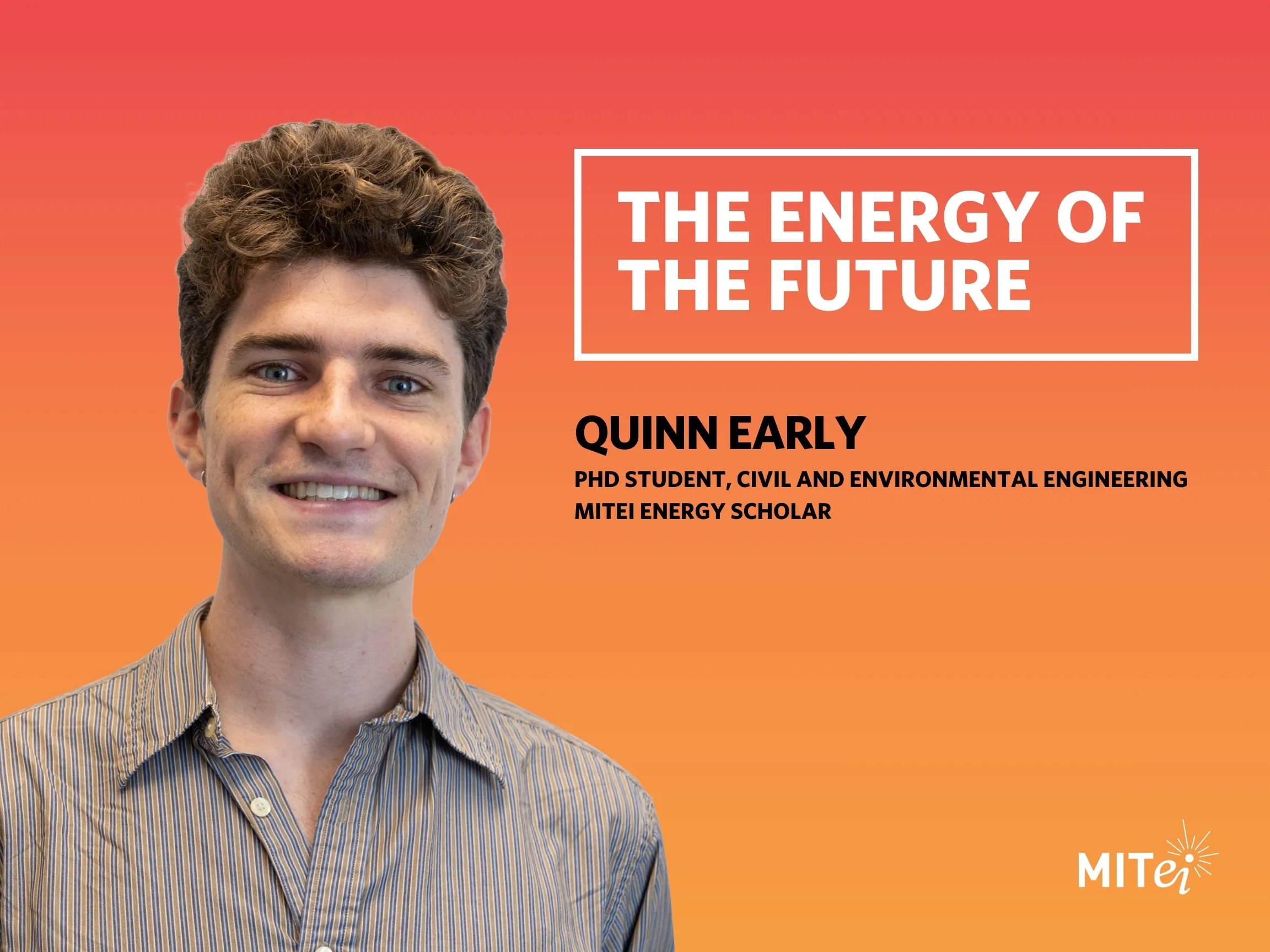
As a MIT Energy Initiative (MITEI) Energy Scholar, Quinn Early developed more robust power prediction models for large wind farms, making these systems more cost-effective and more reliable in a variety of atmospheric conditions. Early, a PhD student in MIT’s Department of Civil and Environmental Engineering, shares how his experience serving with Federal Emergency Management Agency (FEMA) storm response efforts motivated him to work on reducing fossil fuel dependency and building more resilient energy systems.
Q. What are you researching as a MITEI Energy Scholar?
A. As wind turbine diameters continue to grow, especially offshore, it is increasingly necessary to consider the atmospheric responses to wind farms. My research focuses on how varying atmospheric conditions and array layouts affect the power output in large wind farms. I'm interested in how wind turbines generate turbulence, which is the chaotic mixing of air that replenishes the supply of kinetic energy available to be extracted by wind turbines to generate power. Our work looks into the limits of larger wind farms, where many turbines are placed in a small area. Especially in places like Texas, where you have thousands of devices clustered together, there’s a great need for physical models that explain turbulence interactions between turbines and the atmosphere Addressing these challenges is crucial for developing resilient wind energy systems.
As an undergraduate, I had the opportunity to work in a hydrodynamics lab where we studied how fish school together. When fish swim, they generate coherent vortices—whorls of fast-moving water—which help propel them forward. Downstream swimmers align themselves to capture some of this energy, and as a result, fish swim more efficiently in schools than they do on their own. I was curious to see how those fluid dynamics properties could translate into a renewable energy context, which is how I settled on studying wind energy.
Since moving into my current lab, I’ve found parallels between the efficiency of fish schooling and the efficiency of wind turbine arrays. In certain idealized atmospheric conditions, you can see the generation of turbulent circulations above wind farms which bring faster moving, higher momentum air into the wind farm. Turbulent transport is therefore a key driver of the power output in large wind farms. These insights have opened my eyes to the broad array of applications for environmental fluid mechanics and have helped me continue to get excited about this work.
Q. What impact do you hope that this research will have?
A. Our research aims to make wind energy systems more robust to a variety of atmospheric conditions. Most current predictive models for the power output in wind farms assume that you have a neutral atmosphere, meaning that there are no temperature-related buoyant forces. However, this is unrealistic because the heating and cooling of the earth’s surface throughout the day greatly affects how turbulence is generated. My research is focused on improving power prediction models and models of turbulent flow through wind farms to account for these varying atmospheric conditions and allow for wind energy systems to be more adaptive to the local conditions where they are deployed.
By building models that more accurately predict the power output of a wind farm in diverse conditions, we can also improve the cost effectiveness of wind energy. It's expensive to deploy an industry-scale wind farm. The simulations we’re working on aid the design of these large farms, presenting a fast, affordable way to improve efficiency, maximize output, and get the most from your investment. This is especially important with offshore wind, where changing sea conditions at sea bring additional development costs. Our hope is that this work will help large wind farms continue to grow as a source of renewable energy while remaining cost competitive.
Q. How has climate change shaped your perspective on your academic pursuits?
A. I’m originally from Virginia, which has a growing demand for electricity due to the high concentration of energy-intensive data centers there. The consumers in the state—the regular people just trying to keep the lights on—carry the burden of that additional demand as it significantly raises electricity bills. It’s crucial for us to find a solution to modernize the grid while expanding its overall capacity, since energy demand growth shows no signs of slowing.
I’ve also seen the impacts of climate change through my aunt, who is usually an emergency room doctor, but has spent the past few years working on search and rescue teams with FEMA. She worked as a part of their storm response efforts, serving during Hurricane Helene in North Carolina and Hurricane Maria in Puerto Rico. In both disasters—and others—their impacts were severely exacerbated by climate change. Hearing her stories inspired me to take a gap year after graduating from high school and work with AmeriCorps, which gave me the opportunity to serve in FEMA response efforts in Iowa, where they’ve had severe windstorms in the past few years. Those storms damaged crops, uprooted tons of power lines and trees, and caused billions of dollars' worth of damage to energy infrastructure. Through those experiences, I’ve been motivated to work in a space where my everyday efforts go towards reducing our dependency on fossil fuels and helping to mitigate the negative impacts of climate change.
MITEI’s Energy of the Future series highlights in video and text MIT students working to advance the energy transition and expand energy access.

