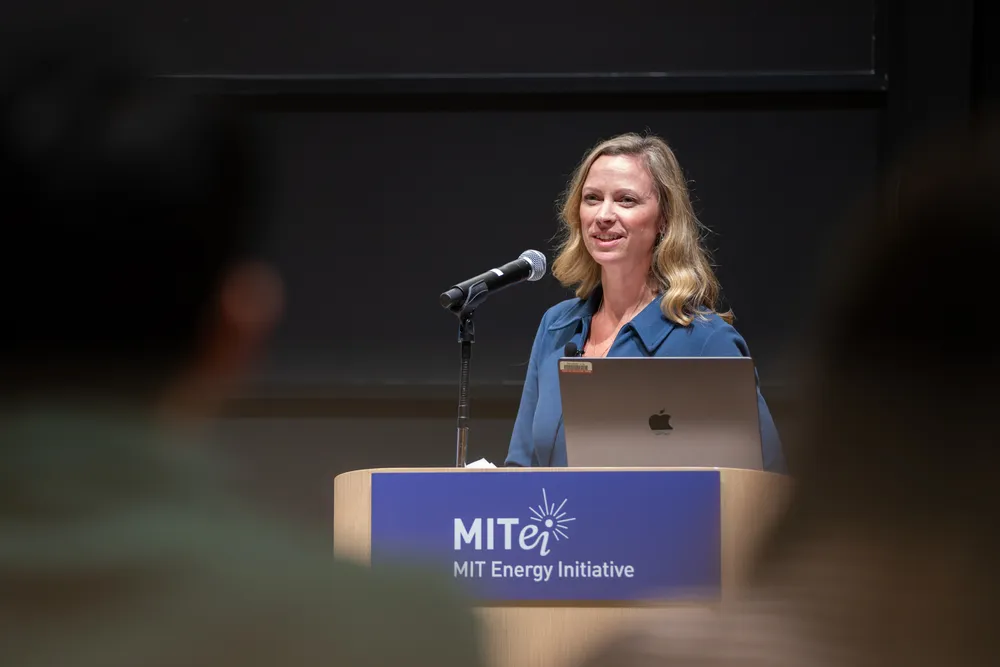
At a recent MITEI seminar, Molly Morris, senior VP at Equinor U.S., discussed how the company is continuing to provide reliable energy for the world while balancing the energy trilemma of security, affordability, and sustainability.
Balancing performance while transforming as an integrated power business
Kelley Travers
Equinor U.S. Senior VP outlines how the company leverages its operational expertise to become a broader energy company and continue to evolve within the energy market.
Research areas
“How do we continue to provide secure, affordable energy that society needs today while we're building a low-carbon system for the future?” asked Molly Morris, the senior vice president at Equinor U.S., during an MIT Energy Initiative (MITEI) Presents: Advancing the Energy Transition seminar.
As an international energy company that started in oil and gas exploration and production in the 1970s, Norway-based Equinor has since expanded to liquid natural gas, battery storage, offshore wind, carbon capture and storage, and lithium extraction—giving the company experience with the full breadth of the energy system and its markets.
During the Oct. 15 seminar at MIT, Morris outlined how Equinor balances performing as a company while also transforming for the future. “This is a very careful process of navigating and course correcting, and we do this with our purpose in mind, which is energy for people, progress for society, and searching for better,” said Morris.
When entering the renewable energy industry, Equinor decided to leverage its existing operational expertise in offshore oil and gas technologies to focus on offshore wind energy, which they continue to develop today. Morris shared that, at that tipping point for the company, Equinor supported policy frameworks for the development of offshore wind, while also developing and retaining capabilities to build large infrastructure projects so they could be operators of these assets.
“This meant that we were going to disrupt part of our own market. We were bringing in a new form of energy generation that we thought might reduce the demand for our end products, such as natural gas,” said Morris. “In actuality, it became a natural transition for us to become a broader energy company since the incumbent industry could actually be an enabler for us rather than a roadblock.”
Equinor’s current approach is “perform and transform.” The perform aspect deals with executing all projects currently in the works and capturing the value of assets in operation through 2030. Transform is about building towards a low-carbon future and becoming a net-zero company by 2050. Morris explained that these aspects work in tandem as strong performance today gives the company the financial capacity and confidence to invest in the future. “It's critical that we can continue to deliver energy security while we grow our business for the future, so the heart of our strategy is to provide reliable energy for the world while we're balancing the energy trilemma of security, affordability, and sustainability.”
Morris spotlighted Empire Wind, an 810-megawatt project being built south of Long Island, NY, as a U.S. case study for how Equinor has leveraged their oil and gas expertise to develop a new power business. When Empire is complete, its 54 turbines will be capable of powering over 500,000 homes in New York. Although this is not Equinor’s first offshore wind project—there are existing and upcoming UK projects in the North Sea—Empire gives the company entry into the U.S. power industry. Morris called the nearly 10-year process “extremely challenging,” teaching the company a great deal about the permitting, technology constraints, and community building required to take a project of this scale from idea to power generation.
“During [this transition phase], our investors were really scrutinizing our renewables expansion.” said Morris. As a result, the company worked to better utilize the synergies between businesses to convey how this growth business could be additive to the existing one, eventually forming a new business area: power.
“Now, we're looking for opportunities to shift to the next stage of integrated power. Bringing wind, solar, gas, storage, and our power trading business together so they can complement each other in one regional power business, rather than managing them as separate investments,” said Morris.
In closing, Morris highlighted one more aspect of Equinor’s building their power portfolio for the future: durability. “A durable strategy depends on deep local knowledge, diverse assets, and less about trying to predict one outcome,” said Morris.
The energy landscape is ever-changing and constantly being reshaped by powerful trends, said Morris—especially with the advancement of the energy transition. “We're seeing accelerating electrification, rising renewable penetration, growing energy demand, technological innovation, and changing geopolitics,” said Morris. “When you're in this uncertain environment, the challenge is not to predict every change, but to build a strategy that can remain durable and resilient across a range of future possibilities.”