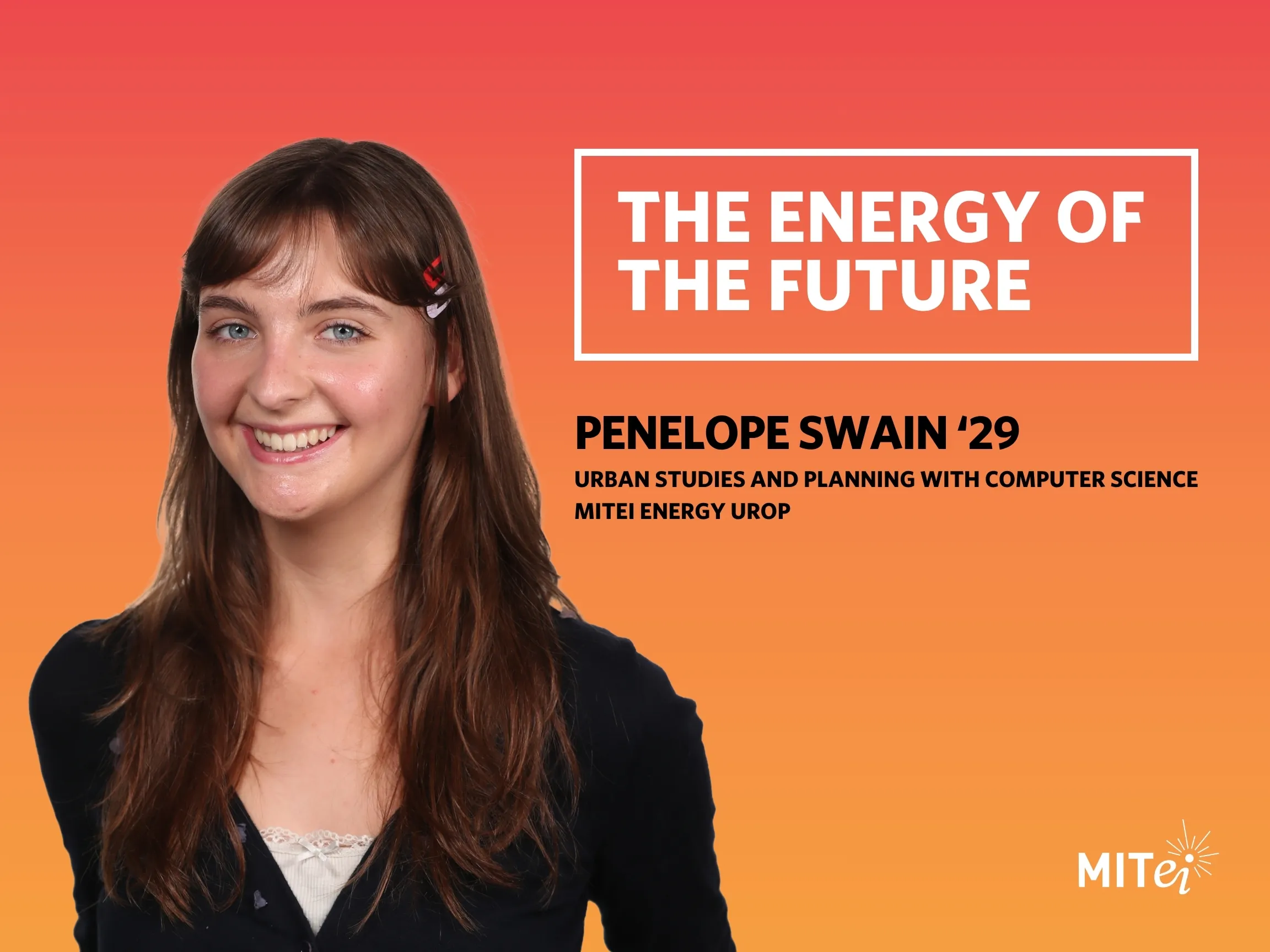
As a part of her MIT Energy Initiative (MITEI) Energy Undergraduate Research Opportunities Program (UROP) project, Penelope Swain ’29 analyzed how solar energy and electric vehicle (EV) adoption impacts the energy burden of low- and middle-income communities in the United States, developing an interactive map to help policy makers evaluate incentive programs. Swain, who is studying urban studies and planning with computer science, wants to ensure that no one is left behind in the energy transition.
Q. What are you researching in your UROP?
A. When implementing renewable technologies, who can afford to be a part of the energy transition is often overlooked. Not only does everyone deserve access to renewable energy, but they also deserve access to affordable energy and a healthy planet. My research focuses on energy equity, which we quantify using energy burden—the percentage of people’s income spent on electricity and energy bills. In particular, we’re analyzing how the adoption of solar power and EVs affects people’s energy burden, particularly in low- and middle-income communities across the United States. Households should be able to access solar panels without the risk of a really high energy bill. If the majority of households are unable to afford these technologies, are they truly impactful?
The deliverable for this project is a map created with ArcGIS, a geographic information system platform. It shows census block groups, a level of granularity that allows users to zoom in and see individual houses and neighborhoods. This level of detail paints a clearer picture of the energy burden in different areas. Prior to this UROP, I didn’t have any programming experience. It was interesting to learn a new skill and to apply it to such a pressing issue. In fact, this project played a large role in me declaring my major in urban studies and planning with a concentration in computer science.
Q. What impact do you hope that this research will have?
A. In the transition to renewable energy, I don’t want to live in a stratified society where those unable to afford these technologies are left behind. This work can identify where those disparities are, both geographically and financially.
In the United States, the primary driver of renewable energy adoption is incentive programs. Our hope is that the map we’re developing can easily show policy makers on the federal, state, and even municipal levels where legislation has been impactful and where stronger incentives are needed to enable better targeted decision-making. For example, community solar programs—where residents can opt-in to share energy generated in a solar field—remove the need for solar panel installation on your property. This was proposed as a way to improve access and initially focused on single-family homes, as applying these programs to apartments is more complicated. Unfortunately, if community solar is run through your utility, there is almost always an increase in your energy bill, as compared to solar panels installed on your home which significantly decrease energy bills, even when accounting for installation costs. Our interactive map could allow for the drawbacks of the program to be more explicitly identified and addressed.
Climate change plays a key role in the urgency of this project, as climate conditions directly impact energy bills. With more extreme temperatures, more energy is needed to heat and cool your home, exacerbating existing disparities in energy burden. This project can highlight areas where properly incentivized solar energy and EVs could help balance out that additional burden.
Q. How has climate change shaped your perspective on your academic pursuits?
A. Climate change has always had a presence in my life as someone raised in Southern California. I’m from Los Angeles, and we’ve been in a drought for many years, so we’ve always been conscious about water consumption. Recently, the impacts of the climate crisis have only become more and more apparent. Last year, my family and I had to evacuate our home during the wildfires. It’s terrifying walking out of your house, being unable to breathe, and seeing the sky turn red as it’s filled with smoke. In part, those experiences are why I want to work in this field to contribute to solving energy and environmental problems.
Something that excites me about going to MIT and working within MITEI is seeing how different people are doing interesting and impactful work related to energy and climate issues. My UROP is tailored to what I’m passionate about and how I want to solve these kinds of problems through computation, maps, and economics. As long as you are passionate about it, you can do it—everyone can contribute with what they are passionate about.
MITEI’s Energy of the Future series highlights in video and text MIT students working to advance the energy transition and expand energy access.