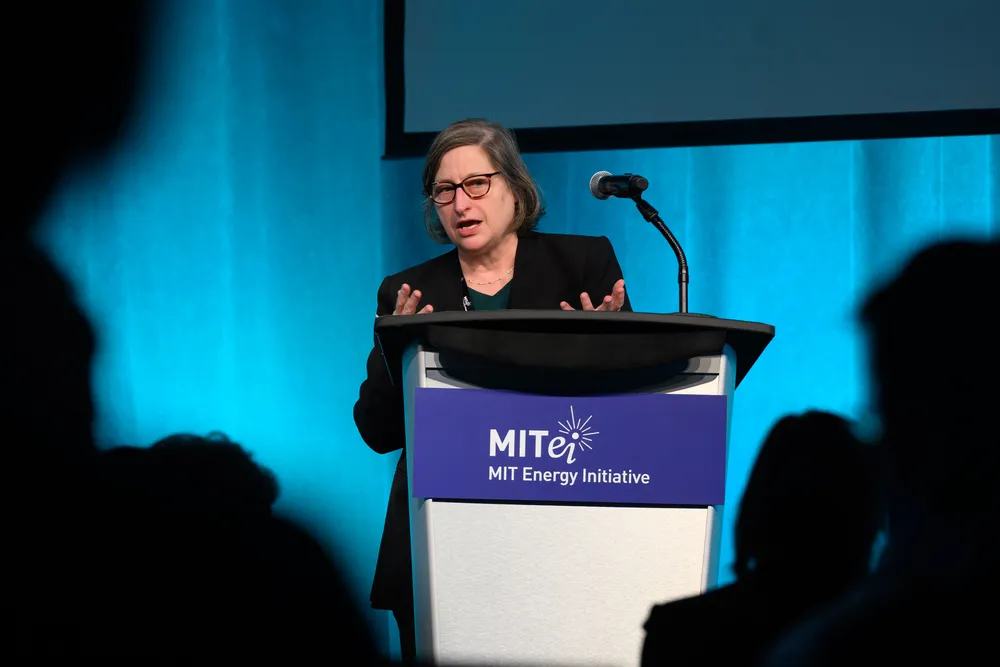
Carolyn Ruppel, the deputy director of science and technology at the MIT Energy Initiative (MITEI), presents at Energizing@MIT: MITEI's Annual Research Conference in September 2025.
MIT Energy Initiative deputy director named fellow of the American Geophysical Union
Gretchen Ertl
Carolyn Ruppel has been selected from among fellow American Geophysical Union members for her exceptional contributions to Earth and space science.
Carolyn Ruppel PhD ’92, SB, SM ’86, the deputy director of science and technology at the MIT Energy Initiative (MITEI), has been elected a fellow of the American Geophysical Union (AGU). She will be honored in December at the organization’s annual meeting.
With ~60,000 members in more than 135 countries, the AGU is the world’s largest professional organization for Earth and space scientists and annually elects less than 0.1% of its membership to fellow status. Fellows are chosen from among AGU members who “have made exceptional contributions to Earth and space science through a breakthrough, discovery, or innovation in their field.”
Ruppel is a marine geophysicist and has had a long research career as a Woods Hole Oceanographic Institution postdoctoral scholar (1992-93), Georgia Institute of Technology professor (1994-2006), and senior scientist at the U.S. Geological Survey’s (USGS’s) Woods Hole coastal and marine research center (2006-2025) before joining MITEI in March 2025. She is a life member of the AGU, has served in various volunteer and editorial roles, and wrote her first AGU meeting abstract 40 years ago as a MIT graduate student.
“Being recognized as an AGU fellow is profoundly meaningful to me, especially since I didn’t even know doing research could be a career when I started out. This honor is a tribute to the training I received at MIT and the excellent support I have had throughout my career from funding agencies, technical staff, collaborators, and, of course, my family,” Ruppel said.
Ruppel is an expert on gas hydrates, an icelike combination of water and concentrated methane that sequesters an estimated 15% of Earth’s massive methane budget. Starting in 2010, Ruppel led the renowned USGS Gas Hydrates Project, focusing on the resource potential of these shallowly buried and widely distributed deposits, as well as possible feedbacks among warming climate, gas hydrate breakdown, and release of methane (a greenhouse gas) to the ocean and atmosphere. In 2011, Ruppel wrote the supplementary paper on gas hydrates for the MITEI study on “The Future of Natural Gas.” Ruppel also led the seminal study debunking catastrophic scenarios for massive gas hydrate breakdown due to global warming and co-discovered over 700 seafloor methane seeps on the U.S. Atlantic margin. Ruppel’s other scientific contributions have been in the fields of continental rifting, subsea permafrost distribution, hydrate reservoir dynamics, and marine heat flow and acoustics.
“I am delighted that Carolyn has been selected as an AGU Fellow, an honor she richly deserves,” said Geoff Plumlee, retired chief scientist of the USGS. “She has led influential and highly cited research on gas hydrates and beyond. She has also tirelessly and selflessly given much back to her profession through her work as a senior advisor to federal executives, her service on editorial and advisory boards, and her role as mentor and champion for her science colleagues.”
Ruppel was previously elected a fellow of the Geological Society of America and served as a National Science Foundation program manager and a distinguished lecturer for the Ocean Drilling Program. In 2024, she was honored with the Distinguished Service Award, the highest recognition from the U.S. Department of the Interior. When she left the USGS in 2025, Carolyn held ST rank, the highest level that a federal research scientist can achieve, which is afforded to fewer than 470 researchers across the federal government.
In her current position, Ruppel supports MITEI’s director, William H. Green, in leading MITEI’s strategic and technical activities. She coordinates among member companies, MIT researchers, and MITEI’s internal teams to manage the portfolio of energy research, education, and outreach that MITEI leads for MIT.