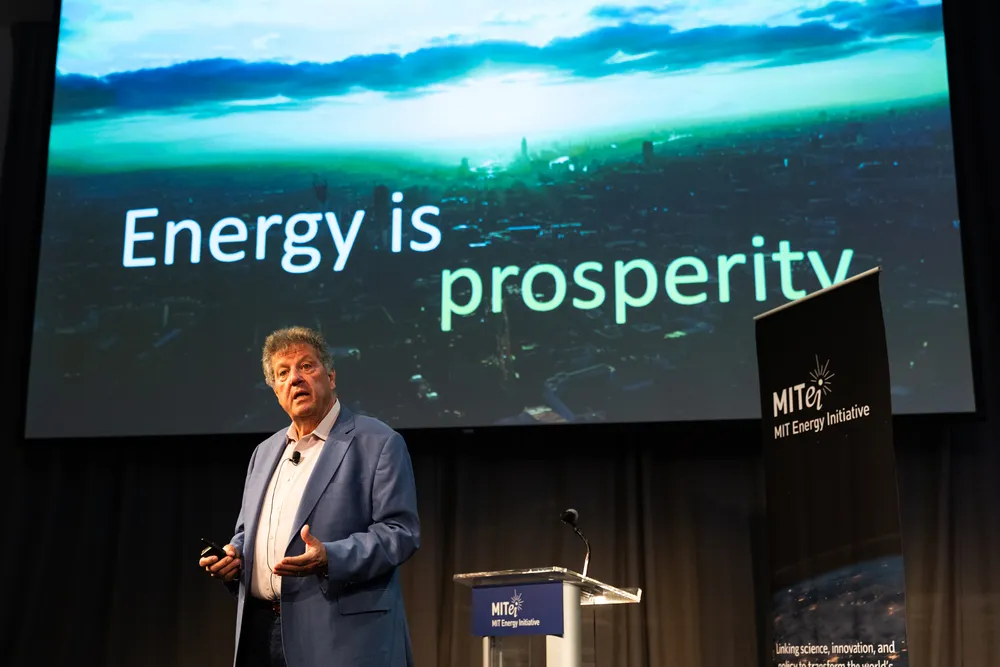
Eric Toone, the chief technical officer at Breakthrough Energy, noted the connection between energy and prosperity during his keynote address at Energizing@MIT: MITEI’s Annual Research Conference in September.
Energy, prosperity, emissions, and innovation: A decarbonization progress report
Jake Belcher
The CTO of Breakthrough Energy assessed global decarbonization and the opportunities and challenges that remain at MITEI’s annual research conference.
Research areas
While rising global prosperity increases energy demand and resulting greenhouse gas emissions, promising low-carbon technologies offer reason for optimism. Eric Toone, Breakthrough Energy’s chief technical officer, gave this assessment in his keynote address at Energizing@MIT: MITEI’s Annual Research Conference in September.
“Energy is how we make things…build and heat our homes…grow and prepare our food. So, energy is prosperity,” said Toone.
Toone oversees the technological roadmap and evaluation at Breakthrough, which is a network of organizations founded by Microsoft’s Bill Gates to accelerate clean energy innovation. Toone also serves as a managing partner of Breakthrough Energy Ventures, the venture capital arm of Breakthrough Energy.
“This correlation between energy use and prosperity persists across a huge group of countries, and importantly, there are no high-wealth/low energy-use countries,” said Toone. Worldwide income parallels electricity consumption as they both climb, according to data shared by Toone. And in the past five decades, the middle class has been expanding worldwide, so prosperity has been increasing.
Given that 80% of global energy use is energy from fossil fuels and 35% of electricity comes from coal, that prosperity results in emissions, declared Toone. Moreover, a rise in prosperity induces a set of behaviors that contribute to the production of emissions. We build more, drive more, eat more, and so on. Still, we need to decarbonize, and we know how to do it, Toone said.
“Of course, we can decarbonize. It’s not hard to do. The question is, How much will it cost?” One approach is to think about how much it would cost to replace each of our business-as-usual products with equivalent zero-carbon products. Considering all products worldwide, and how much extra we’d pay per ton of carbon eliminated, we can calculate the total cost to the global economy to decarbonize.
But, he said, what it would cost is only half the question. The other half is, What are people willing to pay? While wealthy people in the developed world will say some percent, observations of their behavior—“when nobody’s looking”—show that they won’t pay anything at all. Toone adds, “And that’s in the OECD world, where we can actually afford to do it!” OECD is the Organization for Economic Cooperation and Development, a world trade organization.
Breakthrough Energy and its collaborators enlisted artificial intelligence to analyze what it would cost to decarbonize the global economy and AI estimated it would cost about $7.5 trillion. While that’s a big number, global GDP is about $130 trillion, so it’s about 5% of global GDP. But Toone also noted that people—even wealthy people—aren’t willing to pay. So the challenge is figuring out how to do it with zero “green premium,” that is, with no extra charge to use a zero-carbon product.
Breakthrough Energy was created in 2015 to do exactly that. Breakthrough started with a $1 billion venture fund then raised about $5 billion more. Breakthrough has deployed about $3 billion of that into about 140 companies. Toone described the technologies of some of the companies Breakthrough Energy Ventures has invested in to demonstrate the difference they are making.
- Luxwall has developed and is now manufacturing novel windows that are as insulating as walls. The windows are sized to fit into conventional frames. One commercial building recorded a 30% energy savings as a result of installing the new windows. Toone predicted that this product would be the “new LED bulb. We all swapped out incandescent for LED bulbs because the energy saving was so big and so obvious. This is what's next.”
- Brimstone is aiming to reduce the 8% of emissions that come from making cement. And as the emerging economies come along, they do a lot of building. So, finding a way to decarbonize cement is critical. The company is mining a different source of critical raw materials that contains a lower concentration of the conventional cement feedstock used today but also yields valuable metals including aluminum.
- Ecocem is investigating a recent discovery as it also seeks to reduce emissions related to making cement. Controlling the particle size of the cement enables much more effective packing, thus reducing the total amount of cement needed.
- CarbonCure Technologies is adding carbon dioxide to cement as it's being poured to yield cement that's harder, resulting in a 10% reduction in the total amount of cement that’s needed.
Another challenge in the energy transition is how we make and distribute electricity and how much that costs. Solar and wind are some of the cheapest sources today, but both are intermittent. Breakthrough companies are addressing two ways to solve that problem: First, by moving the electricity from where it’s abundant to places where it's needed; and second, by storing it when it’s abundant so that it's available when it’s needed. Here are some examples:
- TS Conductor is building transmission wires with a solid core that keeps them from sagging, touching vegetation, and potentially starting fires. “That means I can put up to three times as much energy down an existing transmission corridor,” said Toone.
- VEIR, a company founded by a MITEI Energy Scholar, is using superconducting cables that can transmit 10 times as much power down an existing corridor.
- Form Energy, a spinout from MIT, is developing iron-air batteries that can store power for as long as a month or even a couple of months.
The other thing we could do would be to put our solar collectors where there isn't an intermittency, for example, space. “If I go to space, the sun always shines,” said Toone. The idea of space-based solar has been around for a long time. The challenge is the cost, particularly the cost of “getting stuff into space,” he said. A Breakthrough company called Stoke Space Technologies is building reusable rockets to solve that problem.
Geothermal energy, that is, the energy that's contained as heat in the Earth, is another option for generating electricity. Fervo Energy, another Breakthrough portfolio company, is drawing on advances in drilling technology that came about for fracking. The company is now building the world's first large-scale geothermal power plant in Southwest Utah, the Cape Station power plant. The plant is already generating 500 megawatts—continuously, regardless of the weather at the Earth’s surface.
Another source of always-available power is fusion energy, but the main challenge with fusion is containing materials at temperatures equivalent to temperatures in the core of the sun. A physical vessel is not an option. Containing them in a magnetic field is the approach that’s the furthest along. Commonwealth Fusion Systems, an MIT startup and Breakthrough-supported company, is a leader in this approach. There, researchers have created high-temperature superconducting tapes that generate the enormous magnetic fields needed to contain those high-temperature materials.
The potential of all of these technologies, if successful, could reduce the cost to decarbonize the world economy to $3.5 trillion—half as much as the initial estimate, Toone said.
The $5 billion that Breakthrough is investing is only a fraction of the total global investment in clean energy, Toone said. About $220 billion has been invested in clean technology during that same period of time, and venture capitalists have invested about $2.5 trillion, he said.
The biggest challenge that Toone sees is that the world has an enormous existing infrastructure that has to be turned over. So, it's critical that those new technologies be deployed in the developing and emerging world so there’s not another enormous infrastructure that has to be replaced.
“We can do this! We can absolutely develop new technologies that provide the exact same service but at zero carbon,” Toone said. “We can absolutely do this.”

